
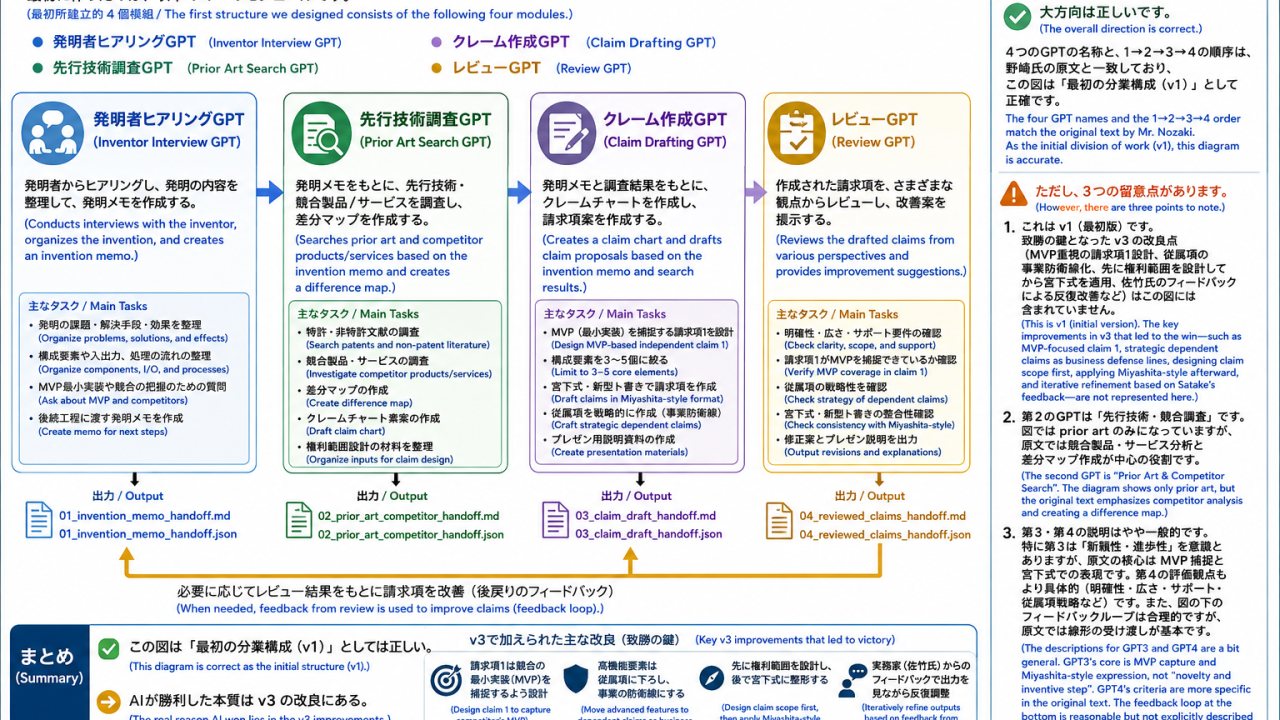
In Part 1, the AI side won Match 1 under fully blind judging. The simplest description of that result is that an analyst who does not draft claims for a living, using ChatGPT, beat a 25-year veteran. According to the winner himself, that description is misleading.
Ten days after the match, Atsushi Nozaki published a full account of his method, including the prompts he used. He begins by rejecting the obvious reading of the result:
「この結果を『クレーム作成の素人である野崎篤志が、生成AIを使って弁理士に勝った』と捉えるのは、かなり不正確だと思っています」 ("Framing this result as 'Atsushi Nozaki, an amateur at claim drafting, used generative AI to beat a patent attorney' would be quite inaccurate.")
His alternative framing is the most substantive point to come out of the match:
「AI野崎 vs 人間宮下さん ではなく、AI宮下さん(野崎作成) vs 人間宮下さん という構図に近かった」 ("It was less 'AI Nozaki vs. human Miyashita' and closer to 'AI Miyashita, built by Nozaki, vs. human Miyashita.'")
Nozaki's claim is not that he out-drafted a veteran, but that he built an approximation of the veteran and entered it into the contest. Whether that was possible turns out to depend entirely on his opponent.
Why "AI Miyashita" was possible
An expert whose method exists only as intuition cannot be reproduced by a language model. An expert who has written the method down can be.
Miyashita had written a good deal of his down. Over the years he had turned much of his claim-drafting approach into explicit rules, most notably a structured convention he calls the "new stage-direction style" (新型ト書き): treat a claim as a set of subject phrases and explanatory phrases, keep one meaning per clause, move from general to specific, and organize the text so that infringement charts and English translation are straightforward. Because these principles were documented rather than tacit, they could be given to a model as instructions.
Nozaki also went beyond the published method. In his retrospective he describes loading the essence of roughly sixteen of Miyashita's own granted software patents into the system, so that the AI would reflect not only how Miyashita describes his drafting but how he actually drafts. In other words, "AI Miyashita" was assembled largely from Miyashita's own public record.
This is the part of the result that deserves attention. Miyashita was reproducible in part because he had documented his craft clearly. The more thoroughly an expert records their method, the easier it becomes to approximate them.
The pipeline was not the decisive part
Part 1 listed the four ChatGPT personas Nozaki built, one for each stage: inventor interview, prior-art search, claim drafting, and review. The division itself is reasonable engineering, but it is not what decided the match. By Nozaki's own account, the first version of the pipeline produced claims that were readable, faithful to the invention memo, and commercially weak.
The weakness was a familiar one: the AI put the invention's full feature set into claim 1. The result looked thorough but was easy to design around, because a competitor shipping a simpler implementation would fall outside the claim.
The correction did not come from a better prompt. It came from a second person.
The feedback loop that mattered
In the week of preparation before the match, Nozaki showed the AI's output, not his prompts, to a patent-attorney friend, Seiji Satake, over several online meetings. Satake reviewed only the results. His main criticism was the claim-1 problem above, and his recommendation is one most practitioners would recognize: write claim 1 around the minimum a competitor would actually ship, keep it to a few elements, and move the full-specification features into dependent claims used as business defense lines rather than as a list of examples.
Nozaki then added a sequencing rule: design the scope of protection first, and apply Miyashita's formatting only afterward. Applied in the other order, the formatting tends to push the model toward enumerating everything in the memo. Scope first, style second.
Over that week the pipeline moved from v1 to v3, less through rewording than through a human expert reading the outputs and identifying what was wrong. Nozaki summarizes the process in one line:
「GPTsは一発で完成しない。出力を見て育てるもの」 ("GPTs are not finished in one shot. You raise them by watching their output.")
What happened on the day
On stage, Nozaki appeared relaxed. In his retrospective, he says he was not. The reason is practical. In his practice runs he had given the system plain text and it responded quickly; on match day he also uploaded the presenter's PDF, and the pipeline slowed considerably, with the interview and prior-art steps alone taking roughly six to nine of his twenty-five minutes, far longer than in rehearsal.
He compensated by running two routes at once: the full four-stage pipeline and a faster fallback that generated a claim directly from the invention memo. That left him with two versions of claim 1. The version from the full pipeline finished only in the final seconds, and he substituted it in at the last moment. The claim that won was placed on the page with very little time to spare, and the review persona, applying the compression Satake had pressed for a week earlier, was what kept claim 1 from being over-long.
The point is not that the AI performed flawlessly. The tooling was slow, the timing nearly failed, and what carried the result was human judgment applied in advance through Satake's feedback and in the moment through Nozaki's decision to hedge.
The implication for the profession
Nozaki closes with two observations about the trade that are worth quoting directly:
「形式知化された専門知が、生成AIによって増幅された」 ("Expert knowledge that had been made explicit was amplified by generative AI.")
「AIに代替されやすいのは専門家そのものではなく、形式知化されていない作業の一部なのかもしれません」 ("What is easily replaced by AI may not be the experts themselves, but the parts of the work that were never made explicit.")
Taken together, these clarify the reframing at the top of this piece. Miyashita did not lose to a machine so much as to a documented version of his own method, amplified. And on Nozaki's reasoning, the act that made Miyashita reproducible, writing his method down, is also what would keep an expert valuable in an AI era: the person who can articulate, evaluate, and correct the output remains necessary.
None of this has to be taken on trust. Nozaki has made the system public. All four GPTs are accessible on ChatGPT, and their instruction sets and knowledge files can be downloaded from his article. It is among the more reproducible experiments the field has produced.
In Part 3, we turn to Match 2, where the conditions were reversed: the drafting screens were shown live to the room, the AI operator was a 20-year veteran asked by his firm's president to compete, and his human opponent was a fifth-year attorney working outside his usual field. The audience and the judges reached opposite conclusions.
References
- Nozaki, Atsushi. "【プロンプトあり】クレームドラフティング素人の私が「AI宮下」を作成して感じたこと." note, June 27, 2026. https://note.com/anozaki/n/n75fcf058e484
- Nozaki, Atsushi (host). "特許の鉄人 2026-全プロセス公開" (post-match retrospective livestream). YouTube. https://www.youtube.com/watch?v=2kSoZDozY4A
- Chizaijuku Inc. "特許の鉄人 2026 特設ページ." chizaijuku.com. https://chizaijuku.com/event/iron-patent-atty-2026