
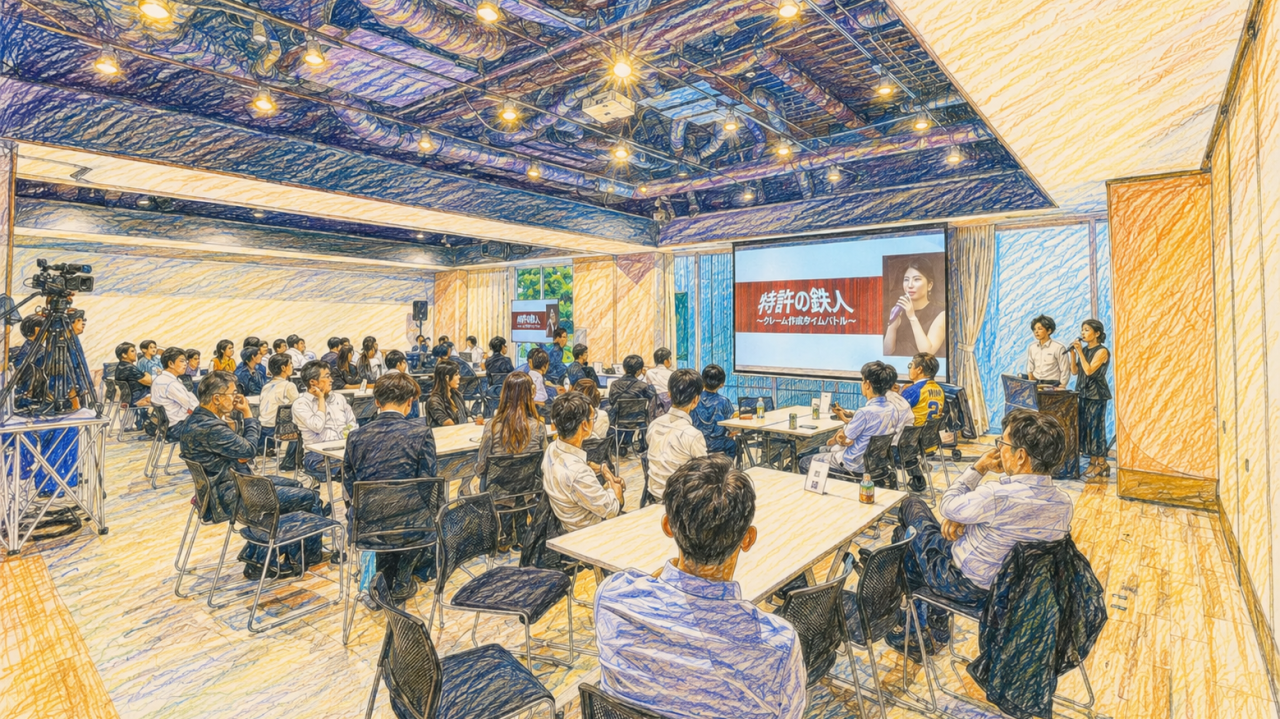
I’ve heard of this contest a lot, but I’m only just checking it out because it’s focused on AI patent drafting. Japan is traditionally regarded as one of the countries with the highest standards of patent professionals and examination quality. And in this market, there exists something almost unheard of anywhere else: a live tournament where patent attorneys draft claims on stage, in front of an audience.
The event is called "Patent Iron Man". On the evening of June 19, 2026, Tokyo, more than 50 spectators, four veteran patent attorneys serving as judges, and over a hundred online viewers witnessed an experiment at this rare event: generative AI versus human patent attorneys, drafting patent claims on the spot under identical conditions.
The result: AI won both matches.
The losers were not amateurs. The human contestant in Match 1, Hiroaki Miyashita, is an in-house patent attorney with 25 years devoted to IP, having worked across patent firms and the IP departments of electronics, food, and cosmetics companies. His opponent, Atsushi Nozaki, a patent information analytics consultant, does not draft claims for a living at all. An analyst who doesn't write claims professionally, armed with generative AI, defeated a 25-year veteran in a blind test.
This was "Patent Iron Man 2026: Generative AI vs. Human."
How the battle works
Now in its fifth edition, the event was created by patent attorney Hiromoto Kashima, now deputy head of IPTech Patent Attorneys. Since its third edition it has been organized by Chizaijuku Inc., an IP education and events company led by its representative director, Mutsumi Kamiike.
The rules are simple and brutal: two contestants face an invention they are seeing for the first time that day. Within 25 minutes, they must listen to the invention briefing, interview the inventor, and draft a set of claims on the spot, with a maximum of five claims. Each contestant then gives a 3-minute presentation and takes questions from the judges.
The subject matter is no toy problem. Match 1's invention was an image-based inspection system actually commercialized by JR West. The presenter, patent attorney Tadanori Nakamura, was himself the person who drafted and successfully prosecuted the real patent. The contestants were, in effect, going head-to-head against a real-world granted patent, in 25 minutes.
Scoring runs on two tracks: each of the four judges holds 10 votes, while every audience member, in the venue and online, holds one. The judging criteria are threefold. Does the claim accurately capture the point of the invention? Does it clearly distinguish over the prior art? And is it a claim that would actually be useful in business, one you could enforce in an infringement case?
This year's special rule: in each match, one side uses generative AI, the other relies on human skill alone.
Match 1: Even the judges didn't know which claim was AI's
The first match, the "software battle," added one more layer: fully blind judging. In past editions, contestants' drafting screens were projected live for the whole venue. This year, Match 1 concealed everything: no live screen, no pre-vote presentations. Judges and audience saw only two anonymous finished claim sets. Nobody knew which one came from the 25-year veteran and which from the AI. The organizers even added a side game: guess which one the AI wrote.
Even more theatrical was the AI side's preparation. In a pre-match interview, Nozaki revealed his strategy. He had the AI ingest patent publications that Miyashita had prosecuted in the past, deliberately making the output mimic his opponent's drafting style:
「宮下さんが過去に代理した特許公報をAIに読み込ませ、宮下さんの特徴を入れ込んだクレームを作成する作戦」 ("A strategy of having the AI read patent publications Miyashita had previously handled, and drafting claims infused with Miyashita's characteristics") (Atsushi Nozaki, pre-match interview, Manmaru Omochi, June 6, 2026)
Using AI to disguise yourself as your opponent, in order to defeat a blind test. This is no longer just "can AI write claims." It is style mimicry deployed in an adversarial setting.
The vote went to Nozaki, the AI side.
So why did AI win? Three views from the room
The judge who voted against it. If you imagine the experts were unanimously won over by AI, consider the post-match reflection of judge Aiko Kaneko. After analyzing both claim sets item by item, without knowing who wrote which, she cast all 10 of her votes for the human side:
「私は1:9くらいの評価で、宮下選手に票を入れました」 ("My assessment was about 1:9, and I gave my votes to Miyashita") (Aiko Kaneko, judge's retrospective, note, June 23, 2026)
Her reasoning was hard-nosed: the AI's claims spelled out the system's internal processing in exhaustive detail, while the veteran's claims focused on a single point, the "display." If you ever had to assert the patent, the latter would be far easier to prove infringement of. And only the human contestant had written the invention's most practical feature, the two-stage threshold setting, into his claims.
Yet she also offered the sharpest explanation of why the majority went the other way:
「良くも悪くもAIは『書きすぎ』ていました。このため、パッと見で、AI作成のクレームの完成度を高く感じてしまう」 ("For better or worse, the AI 'overwrote.' Because of this, at first glance, the AI-drafted claims felt more polished and complete") (Aiko Kaneko, ibid.)
Write more, write in finer detail, and the work looks more professional, even if those very details could tie your hands when it comes time to enforce the patent. In a blind format where only the finished text speaks, and evaluation time is limited, AI's quantity overpowered the human's precision.
In my view, the format made this almost predictable. Twenty-five minutes favors the side that can produce a full draft fast, and that was the AI. The scoring did not help the human either. The judges were mainly asked whether the claim captured the inventor's intent and stood apart from the prior art, with little explicit weight on whether the patent would be easy to enforce. That is exactly where the human's lean claim was strong, and it got no credit. And because Match 1 was blind, with no presentation, there was no chance to explain why a shorter claim can be the better starting point. A lean claim that is never explained can simply look weaker than a fuller one, even when it is not.
The inventor on stage. Nakamura, who presented the invention and had drafted the real patent behind it, did not dispute the outcome, but pushed back against reading it as a rout:
「結果はAIが人間に勝つという結果でしたが、発明者からみたら各選手それぞれ異なった視点でクレーム作成しており、良い試合だったと思います」 ("The result was that AI beat the human, but from the inventor's point of view, each contestant built their claims from a genuinely different angle, and I think it was a good match") (Tadanori Nakamura, retrospective, note, June 29, 2026)
The spectator's chill. For Tatsuya Yabuuchi, a patent translator watching from the audience, the evening carried an unmistakable sense of déjà vu:
「かつて、将棋や囲碁の世界で起きたことが似たように起こった、という結果になりました」 ("What once happened in the worlds of shogi and Go has now happened here in much the same way") (Tatsuya Yabuuchi, event report, note, June 20, 2026)
One more factor should not be overlooked: what beat the veteran was not raw AI. It was AI wielded by a man who had prepared obsessively. Nozaki bought textbooks on claim drafting, and more importantly, built a complete operating system of four ChatGPT personas: an inventor interviewer, a prior-art searcher, a claim drafter, and a simulated examiner for final polishing. One dedicated agent for every stage of the workflow.
In the next post, we dissect that AI workflow in detail, including how the style-mimicry gambit was engineered, and what the judges found when they laid the two claim sets side by side.
References
- Chizaijuku Inc. "特許の鉄人 2026 特設ページ" (Tokkyo no Tetsujin 2026 Official Page). chizaijuku.com. https://chizaijuku.com/event/iron-patent-atty-2026
- Kaneko, Aiko. "【特許の鉄人 2026】審査員振り返り:弁理士としてAI時代をどう生きるか" (Tokkyo no Tetsujin 2026, A Judge's Retrospective: How Patent Attorneys Should Live in the AI Era). note, June 23, 2026. https://note.com/kkak/n/nd67ac7e39235
- Manmaru Omochi. "「特許の鉄人 2026」事前インタビュー・野崎さん・谷さんが語る舞台裏と奇策[後編]" (Tokkyo no Tetsujin 2026 Pre-Match Interview: Nozaki and Tani on the Backstage and Their Tricks, Part 2). note, June 6, 2026. https://note.com/manmaruomochi/n/n3a16fd6c8de4
- Nakamura, Tadanori. "特許の鉄人 2026 振り返り" (Tokkyo no Tetsujin 2026 Retrospective). note, June 29, 2026. https://note.com/nt_iplawfirm/n/n6e9cc95c8e5f
- Yabuuchi, Tatsuya. "特許の鉄人 2026に参加してみて" (My Experience Attending Tokkyo no Tetsujin 2026). note, June 20, 2026. https://note.com/yabutatsu/n/nc9079e6bc765
- Chizaijuku Inc. "【特許の鉄人 2026】イベント開催後記" (Tokkyo no Tetsujin 2026: Post-Event Report). note, June 25, 2026. https://note.com/chizaijuku/n/n77b703e28ff8