
Historically, Taiwanese patents have not received much attention. Win rates for patentees are generally low, and so are the damages awarded. However, thanks to TSMC and the entire semiconductor supply chain that relies on it, the landscape is shifting.
After all, 95% of the world’s AI chips are produced by TSMC and its supply chain here in Taiwan. If you can successfully block a competitor from manufacturing in Taiwan, you effectively have the global AI chip supply by the throat.
These patent wars are often Taiwanese companies fighting other Taiwanese companies (simply because no other country’s supply chain currently has the capability to meet TSMC’s demands). One of the more intriguing cases right now is MSS (汎銓) v. EnliTech (光焱). Both are publicly listed companies in Taiwan involved in the latest CPO chip inspection equipment. What makes this unusual is the intense media war. Both companies are constantly making public statements, pointing fingers, and trying to dominate the narrative.
The Arguments: On one side, the Chairman of MSS personally stepped up to accuse EnliTech of patent infringement. He explicitly stated their intention to monopolize the market and emphasized that they will absolutely not license their patents to Taiwanese peers.
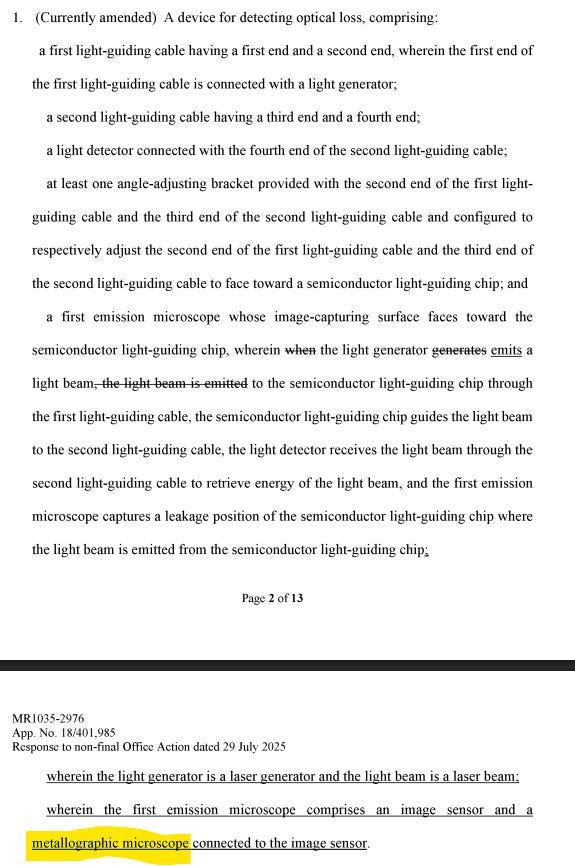
On the other side, EnliTech told the media that MSS’s patent claims are restricted to traditional “metallurgical microscopes” for inspection, which is fundamentally an older generation technology. EnliTech, they argue, uses a much more advanced “hyperspectral imaging sensor module.”
MSS fired back, arguing that as long as an IR (infrared) image sensor is used to receive the optical signals of silicon photonics, it constitutes infringement.
A Closer Look at the Claims: Because both sides were so categorical about the scope of the patent in question, I could not resist taking a closer look. I found that during the patent prosecution process, MSS actually added a clear limitation to the claims: the use of a “metallurgical microscope.” (this limitation was added in almost all of their patent applications across different jurisdictions).
Even more amusingly, during a press conference, MSS presented what they called a “proof of patent infringement.” However, instead of mapping the competitor’s product to the patent claims, it was simply a direct comparison of their product versus the competitor’s product.
The whole situation struck me as bizarre, so I decided to look up the lawyer they hired. It turns out the attorney has absolutely zero experience in patent litigation.
Suddenly, it all made sense.