
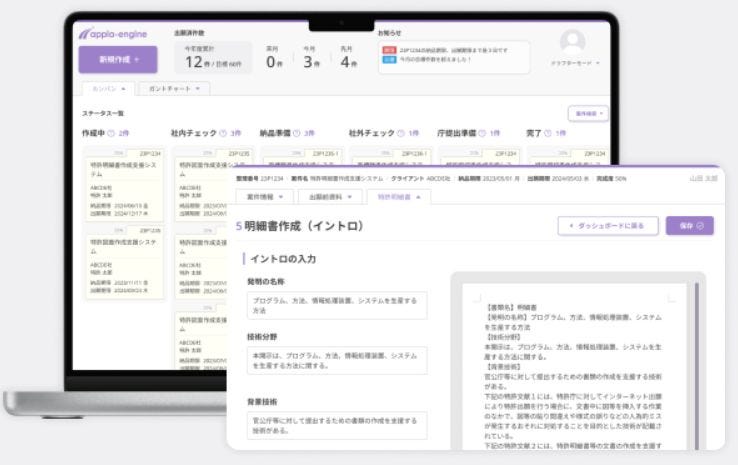
Thanks to the TWPAA for inviting President Yuasa of IPTech to share his insights and give a live demonstration of their software, Appia Engine. There were many valuable practical insights shared:
【Views and Current Status of AI Tools in the Japanese Patent Industry】
➡️ Japan over-relies on the “craftsmanship” of senior patent attorneys. Senior staff are too busy with their workload to train newcomers.
➡️ President Yuasa mentioned that when he founded the company 3 years ago, digital transformation in Japan’s legal, financial, and accounting industries was progressing very rapidly; in contrast, the Japanese patent industry had made almost no progress.
➡️ There are often two extreme opinions in Japan: one is that “with generative AI, practitioners will no longer be needed in the future,” and the other is that “generative AI must absolutely not be used to write patent specifications.” Both views are too extreme.
➡️ Generative AI can only realize its true value when practitioners act as gatekeepers at key points. If it is used by someone without practical skills, it won’t produce any particularly impressive results.
➡️ Senior patent attorneys tend to be more reluctant to use AI tools, but they need to be persuaded.
➡️ AI must be mandatorily integrated into a team’s standard operating procedures, rather than leaving it up to employees to freely choose whether to use it. Why? Because people are usually too busy to figure it out, have a psychological resistance that AI will steal their jobs, or the few who do use it well only achieve a “local optimization” that suits them personally, making it impossible for others to replicate.
➡️ AI tools reaching a truly practical stage is a recent development. Currently, an average of 10 new firms or enterprises start using Appia Engine every month. Some of them are already highly proficient, enabling their firms to complete patent specifications twice as fast as before, or even three times as fast in some cases.
Mastering the Strengths of AI in Patent Work
➡️ AI can help standardize technical terminology and drafting styles within a firm, and automatically perform customized quality proofreading by learning individual clients’ preferences.
➡️ However, AI is highly dependent on the quality of input information. Without personnel with practical skills acting as gatekeepers beforehand, AI cannot consistently produce high-quality content. Currently, AI is also unable to generate practical patent drawings; it still relies on manual drafting and uploading.
➡️ The accuracy of AI in patent search has not yet reached human levels.
➡️ Crucially, AI lacks deep logical thinking capabilities, which is especially obvious when drafting responses to office actions. When facing rejections from examiners regarding inventive step (non-obviousness), current AI can only provide superficial logic like “the cited reference does not have this description.” It cannot deeply explore the differences in problems solved or effects achieved. It still heavily relies on the wisdom of human patent attorneys.
➡️ The key is to clearly write the invention disclosure and confirm the content of the claims; this can achieve about 80% completion. The output content still needs to be fine-tuned by professional practitioners to become an excellent final product.
➡️ For professional practitioners, the time previously spent typing away in a Word document for dozens of hours has been significantly reduced. This allows professionals to focus their time on “conceptualizing, integrating, and deepening ideas” — the areas where they truly exercise their professional expertise.
Attitudes of Japanese Enterprises Towards AI Patent Tools
➡️ Large Japanese manufacturers have begun having inventors input their initial ideas into AI systems, automatically converting them into invention proposal documents to replace cumbersome PowerPoint formats. Corporate IP departments can hand over the proposals preliminarily organized by AI directly to patent firms for evaluation, and even push their partner firms to adopt the same AI tools to achieve a highly efficient workflow from proposal to specification drafting. However, the number of firms and enterprises in Japan that have actually progressed to this level is still very small; currently, probably less than 5% of firms can actually do this.
➡️ Although some enterprises have considered using AI to “internalize” (insource) the drafting of patent specifications, in practice, if patent firms can guarantee quality and delivery time, corporate IP departments generally prefer to outsource the drafting work. This allows them to focus their saved time on higher-value-added core businesses such as IP strategic planning, patent analysis, and investigations.
➡️ Adopting AI has not had a significant impact on billing. From the perspective of corporate IP departments, as long as the final patent specification produced is of high quality, they will not demand a price reduction just because the firm used AI to significantly shorten the working time.
➡️ Conversely, it is also difficult for patent firms to raise their fees to clients based on the cost of AI tools. Therefore, the most substantial benefit of adopting AI is improving profit margins. By maintaining existing fee structures while using AI to reduce the labor costs associated with drafting, firms can enhance their overall profitability and reinvest these saved resources into elevating the client’s patent quality.
Source: President Yuasa of IPTech. Seminar on “The True Value of Intellectual Property Practice Transformed by Generative AI” (appia-engine).