
(Part 4 of a series)
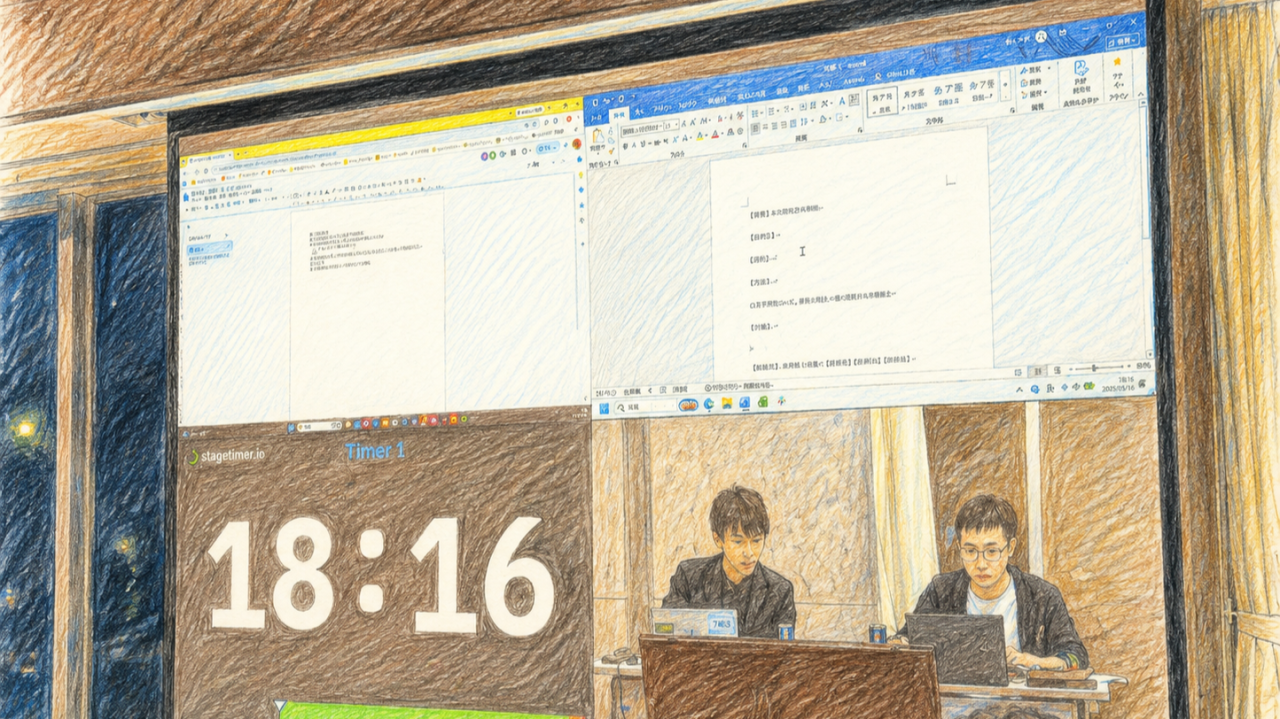
In Match 2, both contestants drafted their claims live on stage, with their screens projected for the whole room in real time as the clock counted down.
This is that match's story. Its winner, Kazuhiro Tani, is a patent attorney with 20 years of practice, and he took the AI side. What he actually did is more useful to know than any headline about AI writing patents. He did not let the AI draft freely. He used it to produce a fast first draft, and then he cut that draft back by hand.
He already had an AI, just not this one
Tani was not a newcomer to AI. He already uses it in his daily practice, and he does not use it as a generic assistant. He trains it on his own work:
「僕のセミナーでの講義資料や僕の明細書を読み込ませることで僕の癖を抽出して僕のコピーを作ることができる機能です」 ("It is a function that lets me create a copy of myself, by having it read my seminar lecture materials and my own specifications and extracting my habits.") (Kazuhiro Tani, contribution, IP Digital Innovation Hub, June 28, 2026)
He uses it through the whole drafting process. He feeds the inventor's materials, the meeting minutes including the claim strategy, and a transcript of the recorded meeting into his Claude, and has it produce claims. He corrects those claims by hand. He then prepares the drawings and the background section, and feeds everything back in so that the model can write the specification, which he corrects by hand again. After enough repetitions of this, he knows what to expect from the tool.
That predictability was important, and the contest took it away. The organizers had assigned him appia-engine, a commercial drafting system that he had used only a little and not for a long time. He could not predict what a given input would produce, so he practised beforehand using teaching material from the courses he runs for trainee attorneys. The veteran went into the match with an instrument he did not know well.
Set the direction first, then feed
Tani's most useful finding came out of that practice. When he fed the tool only the inventor's raw materials, the result disappointed him:
「発明者資料にあるポイントっぽいものを引っ張ってきて、構成要件を軽く肉付けしたような出力でした」 ("It pulled out what looked like key points from the inventor's materials and produced output that just lightly padded out the elements.") (Kazuhiro Tani, June 28, 2026)
He then ran the same weak input through his own Claude, the assistant he had spent years training:
「ちなみに、同じことをClaudeでもやってみましたが、アッピアに割と近い感じの出力でした」 ("Incidentally, I tried the same thing with Claude, and the output was fairly close to appia's.") (Kazuhiro Tani, June 28, 2026)
This is the detail that settles the argument. Two very different systems produced almost the same mediocre claim from the same thin input. One of them was a commercial tool and the other was an assistant he had trained himself. The model was never the variable. What mattered was what the human put in.
So he changed the order. Before feeding anything, he wrote a rough direction for claim 1 himself and decided which elements belonged in it. He then fed that direction in together with the materials, and the precision of the output jumped. That fixed his plan for the day:
「発明理解→大まかな請求項1の方向性作成→アッピアに入力→修正」 ("Understand the invention, sketch a rough direction for claim 1, feed it into appia, then correct.") (Kazuhiro Tani, June 28, 2026)
The order is the point. The human sets the scope first. The AI fills it in quickly. The human then corrects it. The tool never sets the strategy.
What the pruning actually looked like
The method worked on the day of the match. When Tani looked at what came back, he did not dismiss it:
「請求項1を見たときに、悪くない出力だと感じました。これなら大手術せずに戦える請求項にできそうだ」 ("When I looked at claim 1, I felt it was not a bad output. I thought I could turn it into a claim I could fight with, without major surgery.") (Kazuhiro Tani, June 28, 2026)
The tool deserves credit here. It had even tidied up work that he had left for later because of the time limit. This included a case split that he had sketched as two alternatives, and a limitation about which tube sat at the bottom.
He then made his edits. There were only a few of them and they were specific, and they are worth listing because they show what pruning means in practice. The bottom plate was unnecessary, so he removed it. The members did not have to be cylindrical, because a square tube would work just as well, so he broadened that limitation. The movement did not have to be circumferential either, because any direction perpendicular to the vertical would do. Each of these changes makes the claim harder for a competitor to design around.
One of his decisions went in the other direction. He would personally have preferred to avoid the expression "nested," but he left it in on purpose because it makes the structure easy to picture. A claim also has to be understood by the people who are judging it.
In a later discussion with his opponent, he scored his own result at about 80 out of 100. This was not a triumph for the machine. It was a working draft that was produced quickly and then disciplined quickly.
The same input, two different machines
After the match, Tani ran the comparison that his day job made obvious. He fed the exact same competition input into both systems, the appia-engine he had used on stage and his own Claude.
This time the input was a proper one, and the two outputs were different in character. appia was easy to read:
「アッピアは、こちらの請求項の方針に対して発明の概要を『わかりやすく』追加してくれる。なので、可読性が高い」 ("appia adds an easy-to-understand overview of the invention on top of your claim direction, so it reads clearly.") (Kazuhiro Tani, June 28, 2026)
His own Claude produced claims that read like him:
「僕のClaudeは、僕が書いた風の請求項が出てくる。例えば、構成の包含関係をクリアにする」 ("My Claude produces claims that read as if I wrote them, for example making the inclusion relationships between the elements clear.") (Kazuhiro Tani, June 28, 2026)
The two experiments together make the picture clear. When the input was poor, both tools produced the same forgettable claim. When the input was good, each tool expressed it in its own way. appia was easier to read, while his own Claude followed the habits of one particular attorney. The tool shapes the surface, and the human sets the substance.
Where AI still struggles
In the post-match retrospective, the contestants were candid about the limits. Software and IT inventions suit AI well, while chemistry and structural-formula work remains hard. Structural inventions sit in between. They are workable, but only if you feed in the drawings and lock down consistent terminology first. The tool's strength is uneven across fields, and knowing where it is weak is itself part of the skill.
References
- Tani, Kazuhiro. "【寄稿】特許の鉄人にAI側で臨んだ谷弁理士による事前準備&当日振り返り" (Contribution: Patent Attorney Tani, Who Faced Patent Iron Man on the AI Side, on His Preparation and Reflections). IP Digital Innovation Hub, June 28, 2026. https://ipdigitalinnovationhub.substack.com/p/ai-514
- Manmaru Omochi. "【特許の鉄人 2026 振り返り】AI対人間!第 2 試合の舞台裏に迫る" (Patent Iron Man 2026 Review: Behind the Scenes of Match 2, AI vs. Human). note, June 29, 2026 broadcast. https://note.com/manmaruomochi/n/n68a90cba7ff9
- Nozaki, Atsushi (host). "特許の鉄人 2026-全プロセス公開" (Patent Iron Man 2026, Full Process, post-match retrospective livestream). YouTube. https://www.youtube.com/watch?v=2kSoZDozY4A