
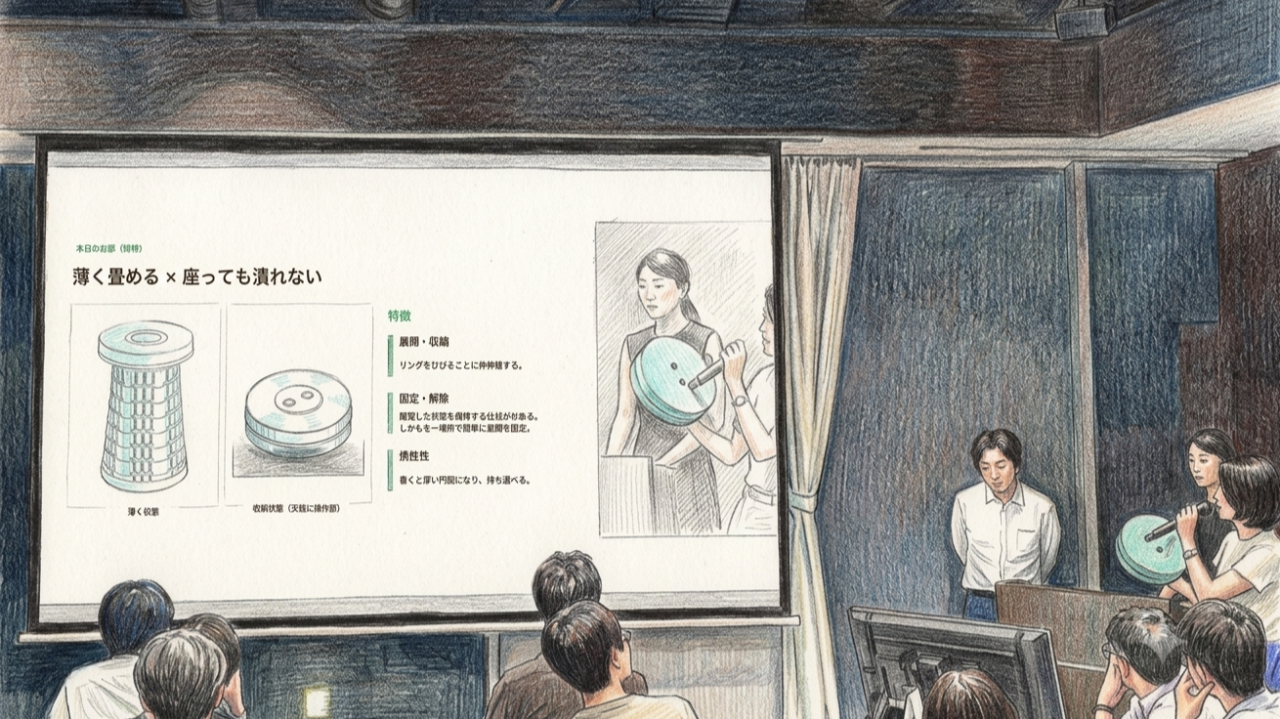
Match 2 returned to the traditional setup, with both contestants' drafting projected live for the room in real time. Match 1 had been judged blind, with nothing shown.
In Part 1, Match 1 asked whether someone who does not draft claims for a living could, with generative AI, beat a 25-year veteran. Match 2 asked something closer to the reverse.
This time the contestant using AI was Kazuhiro Tani, a patent attorney with over 20 years of practice, running Smart-IP's drafting tool "appia-engine." His opponent, Ikuto Hirabayashi, was a much younger attorney, roughly 5 years in patent drafting. The familiar assumption that AI is a crutch for the inexperienced did not apply here. The experienced side was the one holding the machine, and Tani felt the weight of it. In his own account, he knew his opponent was dangerous:
「彼の能力を知っているので僕としては結構嫌な相手でした(ちょっとミスったら負ける)」 ("Because I knew what he was capable of, he was a fairly uncomfortable opponent for me. One small mistake and I lose.") (Kazuhiro Tani, contribution, IP Digital Innovation Hub, June 28, 2026)
The pairing was not a matter of seeding. Tani had been invited by the organizers to take the generative-AI side, and having competed once before, he is the only person to have entered the event twice. Asked whom he wanted to face, he named a younger attorney he already rated highly, someone he knew from study groups and a shared book project. As he put it, the opponent had to combine two things that rarely appear together in a junior practitioner, public visibility and real ability:
「若手ですが、両者を持っている数少ない人だったので選ばれたと理解しています」 ("He is young, but he was one of the few who had both, which is why I understand he was chosen.") (Kazuhiro Tani, June 28, 2026)
Hirabayashi, for his part, went in as the self-declared "analog human," setting out simply to finish a full set of claims inside the limit and against an opponent equipped with AI.
The problem was built to resist AI
The subject was a folding stool: twist the ring and it extends and locks in a single motion, then collapses into a thin disc for carrying. A real product, presented as the output of a fictional company, was placed on stage, along with two invented pieces of prior art, an accordion-style design and a telescoping design whose stages are locked one by one by hand.
The presenter was Chieko Murofushi, who had served as a judge in Match 1. She chose the subject deliberately, and she chose it to be hard for a machine to solve on paper:
「AIにそのまま読み込ませるだけでは解きづらいよう、意図的に動きのある題材を選んでいた」 ("I intentionally chose a subject with movement to it, so that it could not be solved simply by feeding it straight into an AI.") (Chieko Murofushi, note, June 22, 2026)
She went further. On a later program with both contestants, she admitted that the briefing materials had been stripped on purpose, leaving out the very thing an AI would want to read:
「AIにそのまま読み込ませるだけでは解きづらいよう、意図的に資料から原理の説明を省くという意地悪をしたんです」 ("As a bit of mischief, I deliberately left the explanation of the mechanism out of the materials, so that it could not be solved just by feeding it straight into an AI.") (Chieko Murofushi, Manmaru Omochi, note, June 29, 2026)
The effect was that a contestant could not understand how the stool stayed extended without handling the real object. Tani, on the AI side, had to pick it up and work it a couple of times before he grasped the locking mechanism.
This is worth connecting back to Match 1. There, the presenter Tadanori Nakamura had designed the prior art so that the invention's first feature was already disclosed, forcing the real difference into the later features. Seen together, both problem-setters were quietly running the same experiment: they were testing AI not only through the drafting, but through subject selection and through how much they were willing to write down. The less that is made explicit on paper, the more the contest rewards a human who can go and touch the thing.
What each side actually did
Tani's approach was to establish a rough direction for claim 1 himself, then feed that, with the inventor materials, into appia and correct the output. The point to note for now is that the tool did not work alone. Even Murofushi, who would build the problem to frustrate a naive AI, credited the quality of Tani's result to the human input behind it:
「使用したAIの精度がよいことはもちろんのこと、熟練の弁理士による整理された入力があったからこその仕上がりなのでは」 ("Beyond the accuracy of the AI itself, I think the result was possible because of the organized input provided by a skilled patent attorney.") (Chieko Murofushi, note, June 22, 2026)
Hirabayashi, working by hand, made a late structural decision that would matter to the judges. He had not originally included an operating part in his main claim, and added it partway through once he focused on a weakness in the prior art:
「当初は操作部をつけていませんでした…操作部によって動くという構成を途中から付け足しました。ただ、そこをプレゼンでうまく説明できなかったことは少し後悔しています」 ("At first I did not include an operating part. I added the structure of movement by an operating part partway through. I do regret that I could not explain it well in the presentation.") (Ikuto Hirabayashi, Manmaru Omochi, note, June 29, 2026)
A split verdict
The audience and the judges disagreed. By Tani's own account, the room went narrowly to the human, while the judging panel went to the AI side.
What nearly undid the AI side was not the AI. It was human error. Tani forgot one of the basic rules of the contest:
「請求項数を5個以内にするというルールを完全に忘れていたため、10個も書いてしまいました。試合後に審査員の金子さんに突っ込まれて気づきました」 ("I completely forgot the rule that limits you to five claims, so I ended up writing ten. I only realized it when judge Kaneko pointed it out after the match.") (Kazuhiro Tani, June 28, 2026)
Judge Aiko Kaneko's scoring shows how narrow this was. On the merits she had the two sides essentially even, in part because Tani's move to a broader term had softened the distinction over the prior art:
「『周方向の移動』を『水平方向の移動』に上位概念化した結果、文献2との差異がフワッとしてしまったのでは…『操作部』をメインクレームにしていた平林選手を高く評価しました」 ("By generalizing 'circumferential movement' up to 'horizontal movement,' the difference over reference 2 became vague. I gave higher marks to Hirabayashi, who put the operating part in his main claim.") (Aiko Kaneko, judge's retrospective, note, June 23, 2026)
The judges as a whole still went to Tani, though only part of their reasoning is on record. Kaneko had the two claims even on the merits and decided on the broken rule. Nakamura, who judged this match and voted for Tani, framed his vote around the person running the tool rather than the tool itself:
「審査員の私は、AIが良い出力を出すように人間がプロンプトを工夫した点を評価しました」 ("As a judge, what I valued was the way the human crafted the prompt so that the AI would produce a good output.") (Tadanori Nakamura, note, June 29, 2026)
The third judge, Hatayama, also voted for Tani, but his reasoning is not published.
The veteran's own read
Tani did not describe his win as a triumph of the tool. He described it as narrowly avoiding an embarrassment:
「なんとかかんとか、20年選手のベテラン弁理士が生成AI武装して若手弁理士に負けることを何とか回避できました」 ("Somehow or other, I managed to avoid a 20-year veteran, armed with generative AI, losing to a young attorney.") (Kazuhiro Tani, June 28, 2026)
References
- Tani, Kazuhiro. "【寄稿】特許の鉄人にAI側で臨んだ谷弁理士による事前準備&当日振り返り" (Contribution: Patent Attorney Tani, Who Faced Patent Iron Man on the AI Side, on His Preparation and Reflections). IP Digital Innovation Hub, June 28, 2026. https://ipdigitalinnovationhub.substack.com/p/ai-514
- Murofushi, Chieko. "枠組みの中で最適化するだけでいいのか—特許の鉄人 2026に参加して悩んだこと" (Is Optimizing Within the Framework Enough? What Troubled Me After Taking Part in Patent Iron Man 2026). note, June 22, 2026. https://note.com/cmurofushi/n/n8e2aff6724a4
- Manmaru Omochi. "【特許の鉄人 2026 振り返り】AI対人間!第 2 試合の舞台裏に迫る" (Patent Iron Man 2026 Review: Behind the Scenes of Match 2, AI vs. Human). note, June 29, 2026 broadcast. https://note.com/manmaruomochi/n/n68a90cba7ff9
- Kaneko, Aiko. "【特許の鉄人 2026】審査員振り返り:弁理士としてAI時代をどう生きるか" (Patent Iron Man 2026, A Judge's Retrospective). note, June 23, 2026. https://note.com/kkak/n/nd67ac7e39235
- Chizaijuku Inc. "【特許の鉄人 2026】イベント開催後記" (Patent Iron Man 2026: Post-Event Report). note, June 25, 2026. https://note.com/chizaijuku/n/n77b703e28ff8
- Nakamura, Tadanori. "特許の鉄人 2026 振り返り" (Patent Iron Man 2026 Retrospective). note, June 29, 2026. https://note.com/nt_iplawfirm/n/n6e9cc95c8e5f