
Cross-section of a composite overwrapped pressure vessel
SpaceX: How Can Rocket Pressure Vessels Withstand Temperature Changes?
Technical problem
Helium pressure vessels used in launch vehicles may face cryogenic propellants and adiabatic heating during pressurization. The patent addresses the need for an epoxy with good elongation at cryogenic temperatures and sufficient strength as temperature rises.
Technical solution
Why must the vessel withstand both cold and heat?

Figures 1 and 2 show a composite overwrapped pressure vessel 100 (COPV) with a central cylinder and domed ends. In the described embodiment, the threaded boss 104 is a port for filling and emptying the vessel. The bearing boss 106 supports it in the launch vehicle while accommodating elongation along its axis.
The patent describes helium pressurization as a demanding application: the vessel may be immersed in cold propellant, while pressurization causes adiabatic heating. Its epoxy composite must withstand mechanical strain across this temperature range. Cryogenic helium storage can also reduce vessel size and weight, as discussed in the NASA background reference.
COPVs inside the second-stage liquid oxygen tank of SpaceX’s Falcon 9 store high-pressure helium for pressurization. The black vessels in the photograph show domed ends and placement inside the tank. They provide a comparison with the shape in Figure 1 and illustrate a cryogenic operating environment for the resin.
These photographs compare vessel shape and placement. The resin formulation, liner and cold- and heat-resistance performance are explained below using the patent drawings and test data.
The formulation: combining two hardeners
The patent explains a trade-off between glass transition temperature (Tg) and cryogenic elongation. Flexible, lightly crosslinked epoxies can perform well at low temperatures, but their strength and modulus fall as temperature approaches Tg. Raising crosslink density can raise Tg while reducing elongation. The disclosed approach instead uses the choice of hardeners to raise Tg without relying on increased crosslinking.
The representative formulation uses bisphenol A diglycidyl ether as the epoxy resin. Its hardener combines the polyetheramine XTJ-568 with 1,8-diamino-p-menthane. In Example 1, the patent identifies the resin as 2,2-bis[p-(2,3-epoxypropoxy)phenyl]propane and gives the following ratios.
| Components | Ratio |
|---|---|
| Hardeners: XTJ-568 to 1,8-diamino-p-menthane | 1:2.5 |
| Epoxy resin (Part A) to mixed hardener (Part B) | 100:28 |
These are two different mixing steps: first combine the hardeners, then mix that Part B with the epoxy resin, Part A. The table presents the representative Example 1 formulation; other embodiments specify permitted variations.
Where is the resin? The vessel’s two-layer structure
In Figure 2, the inner liner 110 defines the vessel’s capacity and supports the fibers during fabrication. The patent describes metal liners made from aluminum, titanium or their alloys and does not generally rely on the liner for strength. The resin impregnated fibers 108 wrapped around it form the composite overwrap.
One disclosed method uses an automated filament winding machine to control the angle of filaments or tapes relative to the vessel centerline. The overwrap is built layer by layer; hoop layers can alternate with helical layers. Fibers are impregnated with the epoxy formulation as they are laid onto the liner or a preceding layer.
After winding: curing through staged heating
The patent describes curing at not more than 265°F (about 129°C), followed by a post cure at about 300°F (about 149°C). A slow temperature ramp and holds at specified temperatures may be used. The disclosure associates post cure and slow heating with improved burst performance; exact time and temperature can depend on the resin.
Post-cure temperature is a manufacturing heating condition. Tg is a property of the cured resin. Operating temperature describes the conditions in which the vessel is actually used.
Test results: a higher Tg with similar cryogenic elongation
Example 2 compares cured test coupons made from the disclosed formulation and the comparative formulation in Example 1. It reports a higher Tg for the disclosed formulation and similar tensile elongation at −320°F (about −196°C).
| Property | Disclosure example | Comparative example |
|---|---|---|
| Cure profile | 265°F maximum cure; 300°F post cure | 250°F maximum cure |
| Glass transition temperature, Tg | 280°F | 180°F |
| Tensile elongation at −320°F | 2.6 ± 0.5% | 2.5 ± 0.4% |
| Tensile strength at −320°F | 22.6 ± 2.6 ksi | 22.7 ± 4.1 ksi |
The Tg values of 280°F and 180°F correspond to about 138°C and 82°C. The comparison includes both a different formulation and a different cure profile. It therefore does not isolate the effect of adding one hardener while holding the process constant.
Example 3 reports average burst pressures for vessels using the disclosed formulation: 8,361 psi in liquid nitrogen at −320°F and 8,048 psi at 240°F (about 116°C), with 30 specimens in each group. These are pressures measured in tests taken to failure, not operating-pressure ratings.
Application context: Vehicle COPVs in the Tesla Roadster
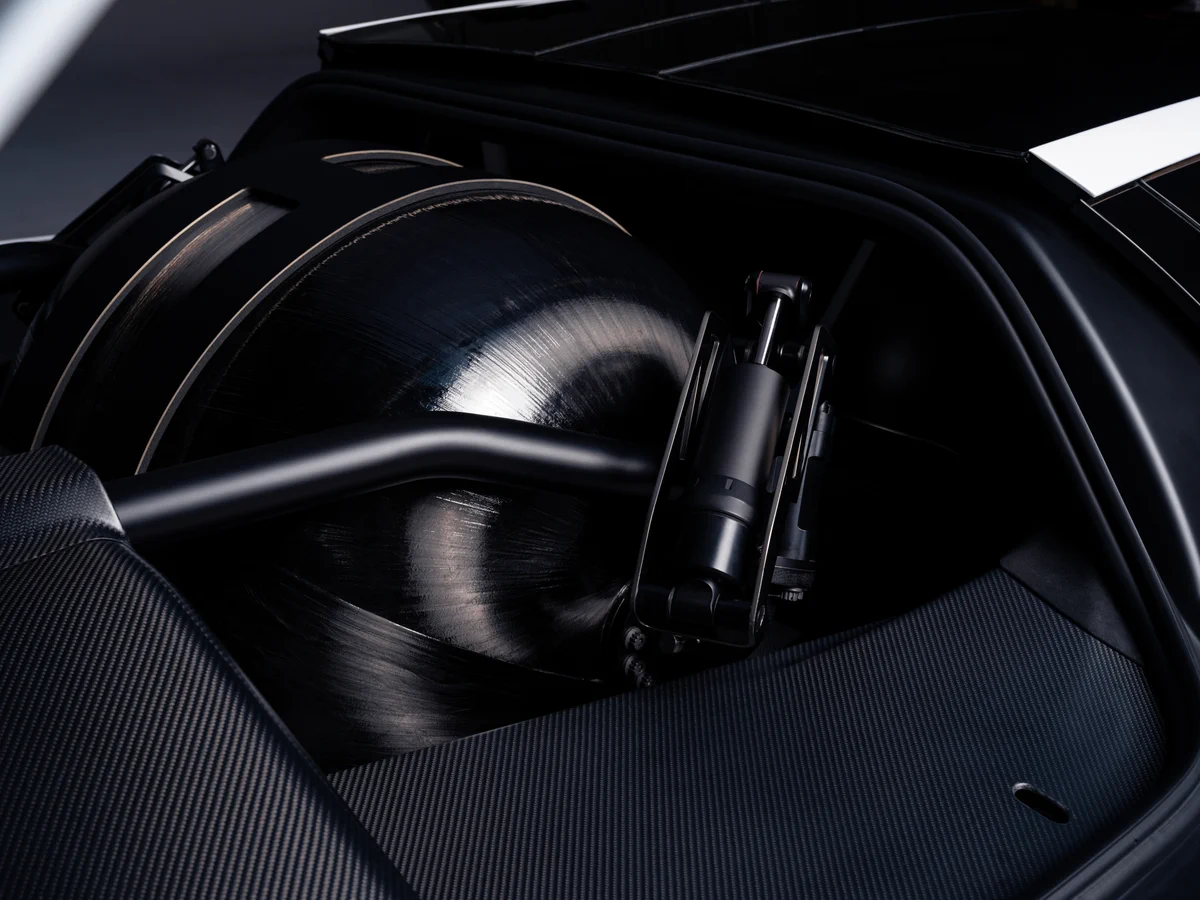
The black COPV in Tesla’s Roadster layout is positioned within the vehicle structure and stores compressed gas for the thruster system. It provides a visual comparison of vessel shape and placement in a vehicle.
* This article explains how the technology is implemented. It does not interpret patent scope or assess infringement.
References
- US11377519B1 Full text
- High Pressure Composite Overwrapped Pressure Vessel (COPV) Development Tests at Cryogenic Temperatures
- NASA Independent Review Team — SpaceX CRS-7 Accident Investigation Report, Public Summary
- SpaceX cree saber qué hizo explotar su cohete en la plataforma de lanzamiento pero no cómo
- SpaceX has used thrusters to position spacecraft for decades.