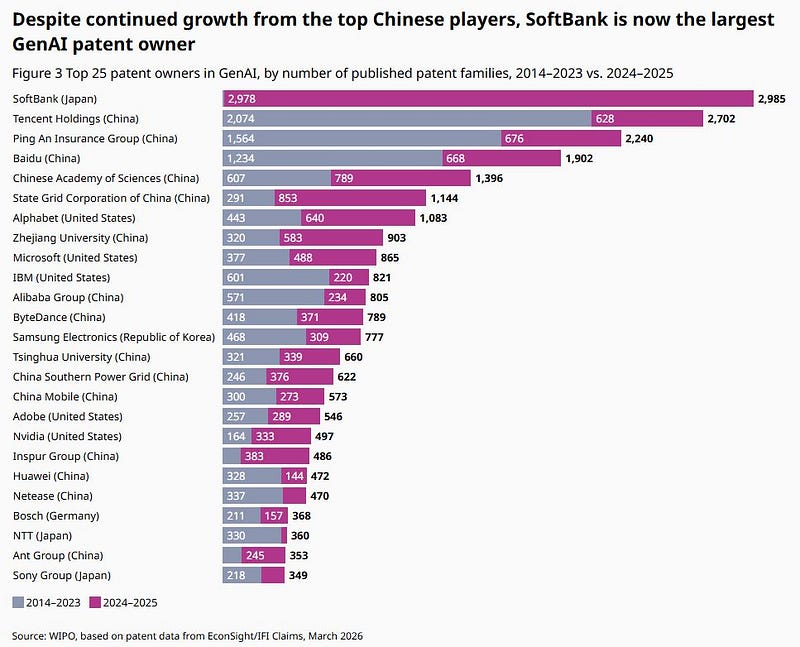
WIPO has released its latest report on AI patent trends. Compared with 2024, the biggest change is that Japan’s SoftBank has become the company with the most AI patents in the world, and almost all of them were filed in a single rush in 2023. (I have written about this before: the quality of these patents, mass-produced by SoftBank using AI, is highly questionable.)
More noteworthy are the three Chinese companies ranking just behind SoftBank:
➡️ Tencent: WeChat already has a large number of AI features built in.
➡️ Ping An Group: provides medical consultation, insurance, and wealth management services.
➡️ Baidu: China’s Google. Its AI products include the Ernie Bot series.
Among the top 25, the US front-runners are Google, Microsoft, IBM, and Nvidia, while OpenAI has filed very few patents. As for Europe, there is astonishingly only one company on the list: Bosch. Most of the other newcomers are, again, Chinese companies, for example:
➡️ Alibaba: online shopping platforms (Taobao / Tmall), navigation map, and the Tongyi AI app.
➡️ ByteDance: social apps (Tiktok), CapCut, and the Doubao app.
➡️ State Grid Corporation of China: a power app covering hundreds of millions of users (where the public can see smart electricity-usage analysis and energy-saving tips); it also uses AI to build a digital twin of the grid, automatically predicting demand peaks and failure risks during typhoons or blizzards.
➡️ Inspur Group: supplies AI servers and racks to Baidu, ByteDance, and telecom carriers, and builds the “digital citizen” apps used in many Chinese cities for handling government affairs, paying bills, and checking social insurance. (More like an arms dealer.)
By country, the top two in total AI patents are China and the US. Japan has overtaken South Korea to become third (mainly because of SoftBank’s surge in filings). Germany has overtaken the UK to become Europe’s number one.
Coming back to the most closely watched issue, the US-China rivalry: the US is led by its tech giants, while China’s AI technology has already penetrated every industry. From messaging software, medical consultation, search engines, online shopping platforms, mapping software, social media, and video processing, to social insurance, power infrastructure, and local government administration, it covers almost everything.
What stands out is a precise division of labor that pushes AI into every vertical industry and into the everyday lives of ordinary citizens. It is very much a Chinese characteristic.