
In the modern business landscape, Innovation and ESG have long been treated as parallel lines: Innovation belonged to the R&D labs, while ESG lived in the compliance office.
With the release of ISO 56001:2024, the first certifiable standard for Innovation Management, those lines have finally converged. It turns innovation from a “random spark of genius” into a systematic, strategic engine for sustainable value.
The Core Link: Redefining “Value”
Under the ISO framework, “value” isn’t just about the bottom line. It encompasses financial and non-financial value. This is where ISO 56001 becomes the tactical bridge to your ESG goals.
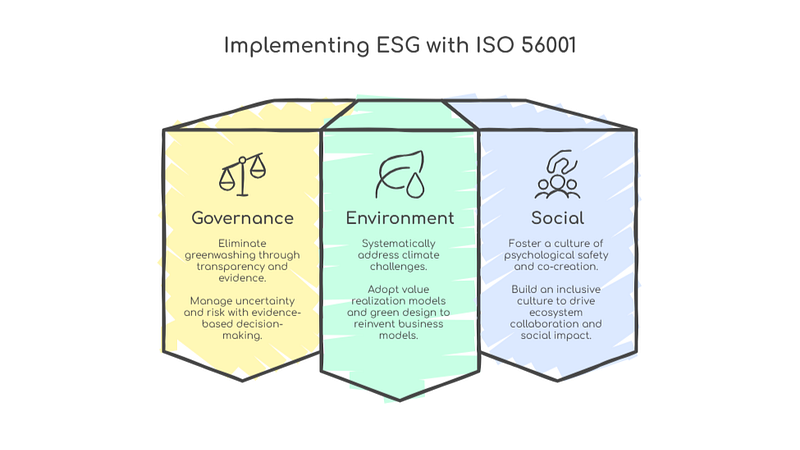
- Governance: Killing “Greenwashing” with Evidence
Governance is the soul of ESG, and ISO 56001 provides the rigorous framework to back it up.
- Leadership and commitment (Clause 5): It moves ESG from a slogan to a board-level strategy. Top management must establish an innovation policy aligned with the organization’s long-term direction, ensuring investment in transformation rather than just quarterly reports.
- Risk & Uncertainty (Clause 6.1): Innovation is inherently risky. By systematically assessing risks and opportunities, companies can build safeguards when exploring new tech (like AI or low-carbon processes), protecting both investors and assets.
- Evidence-Based Decisions (Clause 9): How do you prove your carbon-capture tech isn’t just marketing? Clause 9 focuses on monitoring and measuring “value realization,” providing auditable data that acts as a shield against greenwashing claims.
- Environmental: From Compliance to Breakthroughs
While ISO 14001 focuses on reducing negative impacts, ISO 56001 focuses on creating positive breakthroughs.
- Lifecycle Thinking (Clause 8): The standard encourages integrating “insights” — including environmental regulations and resource scarcity — early in the design phase. This allows companies to build circular economy models directly into the product DNA.
- Business Model Reinvention: Decarbonization is often a business model challenge, not just a technical one. ISO 56001 provides the process to validate “Product-as-a-Service” models, turning waste into resources and environmental costs into “green premiums.”
- Social: Culture as a Management Path
The “Social” dimension is often the hardest to quantify. ISO 56001 changes that through managed culture and collaboration.
- Psychological Safety (Clause 5.4): The standard explicitly requires a culture that supports innovation — characterized by a high tolerance for risk, openness to change, and respect for diverse perspectives. This directly feeds into employee engagement and retention.
- Ecosystem Collaboration (Clause 6.6): Complex social issues (like healthcare access or supply chain ethics) can’t be solved alone. ISO 56001 provides the framework for co-creating with startups, universities, and communities, boosting your social impact scores.
The Operating System for Corporate Longevity
ISO 56001 is designed with a High-Level Structure, meaning it integrates seamlessly with ISO 9001 and ISO 14001. For companies eyeing long-term competitiveness, this standard offers three immediate wins:
- Elevated ESG Ratings: It demonstrates a level of management maturity that appeals to MSCI or EcoVadis.
- Broken Silos: It creates a unified language for R&D, Sustainability, and Business units.
- Profit with Purpose: It balances short-term financial performance with long-term ESG investments through portfolio management.
In an era where ESG is the global language of business, ISO 56001 provides the methodology to prove that you don’t just intend to be sustainable but are also capable of innovating to get there.