
Air pathway from the underbody inlet to the rear outlet, with an electric ducted fan and a raked plate.
Tesla: How Can Rear Fans Increase Grip?
Technical problem
Downforce from passive aerodynamics depends on vehicle speed. This patent describes actively drawing air from beneath a vehicle to increase downforce and help tire grip during cornering and braking, including at lower speeds.
Technical solution
Drawing air from beneath the vehicle
Downforce is a downward aerodynamic force that increases the load on the tires. In the electric vehicle 100, an inlet 13 in the underbody 16 connects through an air pathway 12 to an outlet 14 at the rear. An electric ducted fan 10 draws air through this pathway, reducing pressure beneath the vehicle and creating downforce.
An electric ducted fan, or EDF, uses an electric motor to drive a fan within a duct. Its airflow can be generated actively, rather than relying entirely on air passing over the moving vehicle.
The air pathway 12 also forms a diffuser. The outlet 14 can have a larger cross-sectional area than the inlet 13, allowing the high-velocity underbody airflow to expand and decelerate toward the surrounding air. A raked plate 11 below the pathway can form a second diffuser. These are disclosed arrangements, rather than dimensions prescribed for every implementation.
Arranging the fans across the rear outlet
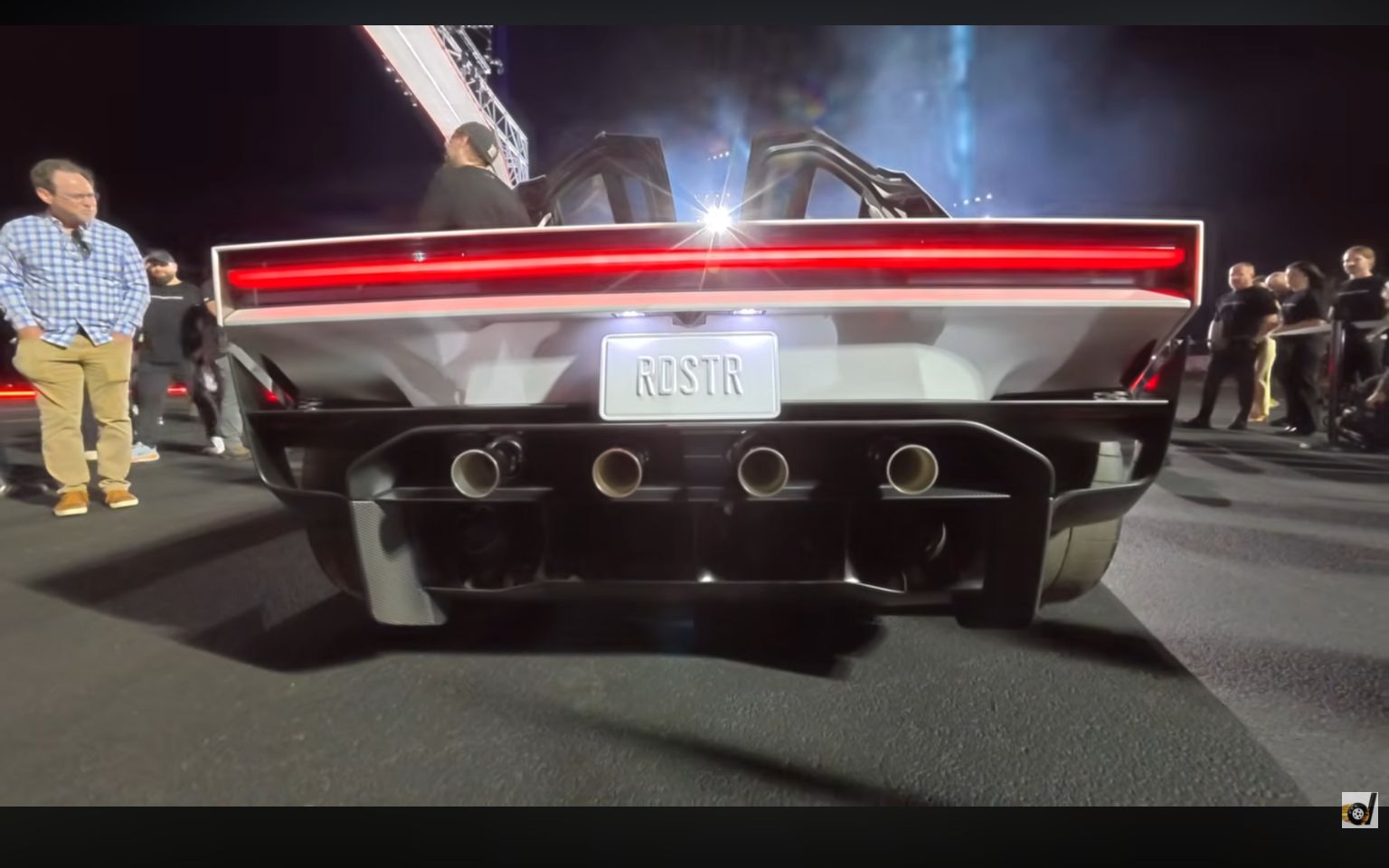
In this rear view, the ducted fan system 1 has four fans across the outlet 14. A strake 15 extends vertically between each pair of adjacent fans. The strakes help control the volume of air flowing through the outlet.
The fans maintain airflow through the pathway, while the outlet and raked plate 11 provide the transition from the underbody to the rear of the vehicle. Four fans and three strakes are the illustrated example; the disclosure also allows other numbers and arrangements.
The DragTimes view of the Tesla Roadster shows the lower fan area beneath four projecting circular tubes. Its position and transverse arrangement can be compared with the rear view in the patent. The engineering interview published by Hagerty describes fans and skirts working together to generate downforce at low speed.
This comparison concerns visible placement and the stated purpose of the fans. The internal air pathways, side inlets and electrical controls are explained from the patent; the photograph does not establish that the vehicle implements every disclosed feature.
Using side inlets to reduce backwash
The main inlet 13 produces a suction region 17 beneath the vehicle, forward of that inlet. Air drawn back from behind the vehicle would reduce the useful suction applied to this region.
Each smaller side inlet 18 lies behind and to one side of the main inlet. Together, the side inlets create low-pressure areas behind the main inlet to reduce backwash from the rear, helping the main inlet draw air from the forward underbody region.
The inlets can share a pathway or use separate pathways. In one disclosed arrangement, the main inlet feeds the two central fans, while each side inlet feeds an outer fan. The air then leaves through the rear outlet 14.
Underbody view showing the main inlet, suction region and smaller side inlets.
Powering and activating the fans
The EDFs can use the same high-voltage battery that powers the vehicle. A power supply and vehicle control system integrate the fans into the vehicle electrical architecture.
A driver can activate the system with an input such as a button. The control system can also respond to detected conditions such as vehicle speed, either activating the fans or prompting the driver to do so.
I also examined the coordinated use of fans and deployable skirts in Tesla: How Skirts Work with Fans (Chinese). That earlier article describes a different disclosed arrangement for controlling the underbody low-pressure region.
* This article explains how the technology is implemented. It does not interpret patent scope or assess infringement.