
Left and right bounded regions served by separate airflow pathways.
Tesla: How Do Skirts Work with Fans to Increase Grip?
Technical problem
At low speeds, passive aerodynamics provides limited downforce. This patent describes a multi-mode powered aerodynamics system that combines fans with deployable skirts, adjusting its operation to ground clearance, road conditions and the driving situation.
Technical solution
Bounding the underbody region and extracting air
The multi-mode powered aerodynamics system 100 uses a fan assembly 102 to extract air through a central airflow pathway 104. Lower pressure in the bounded underbody region produces downforce. The skirts limit air entering that region so that the fans can establish the required pressure difference.
Each side skirt 108 extends along the vehicle, and a front skirt 110 crosses its front underbody. The drawing identifies front skirt portion 112 and front skirt portion 114. Together with a rear skirt, they can form a more fully bounded region. Hinged or extendable skirts can be deployed, retracted or held at intermediate positions to accommodate ground clearance and changing road conditions.
An outboard airflow pathway 106 lies outside the side skirts. Different combinations of central and outboard fans, speeds, blade configurations and pathways can be selected as the skirt boundaries change.
| Situation | Skirt configuration | Fans and airflow |
|---|---|---|
| Smooth surface, low-speed acceleration | Side, front and rear skirts deployed to form a more enclosed region | Primarily central fans, emphasizing pressure reduction |
| Higher speed or uneven surface | Side skirts retained; front and rear skirts adjusted or retracted | Outboard fans may join central fans to increase mass flow and cooperate with vehicle-induced airflow |
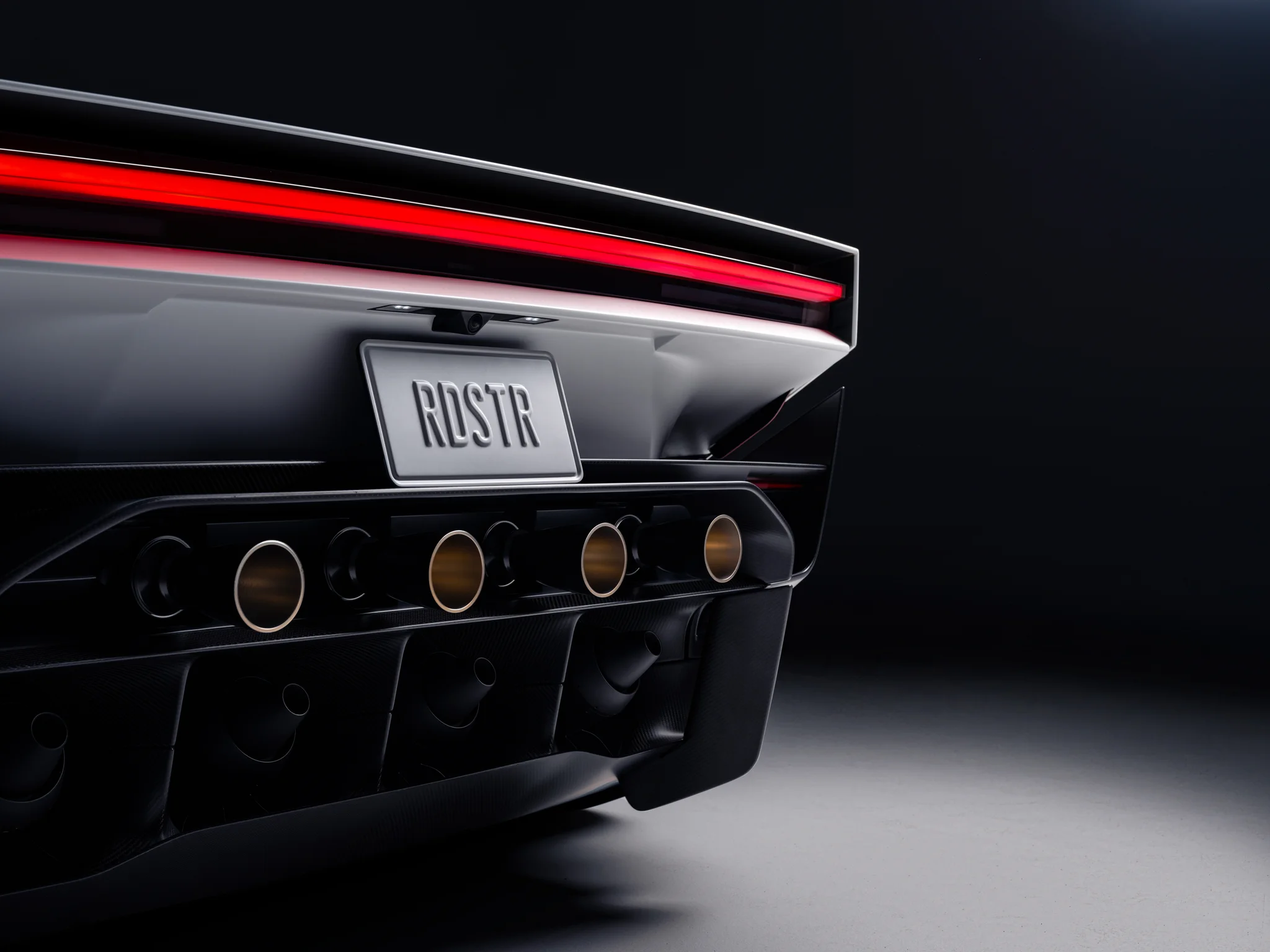
Tesla’s official Roadster photograph shows a transverse lower fan area beneath four projecting circular tubes. It can be compared with the fan assembly (102) in the patent. Tesla’s post describes a “multi-mode fan & ground sealing system” that pulls air from beneath the vehicle. The interview published by Hagerty also describes the use of fans and skirts for low-speed downforce.
The product image provides a visual comparison of the rear fan area. The internal pathways, skirt deployment mechanisms and control architecture described below come from the patent, and cannot all be verified from the photograph.
Controlling the left and right regions separately
A central skirt 212 divides the underbody into bounded region 208 and bounded region 210. The airflow pathway 204 and airflow pathway 206 connect the corresponding regions to a set of fans 202. Fan selection and speed can be adjusted for each region.
Each partition 214 between fans helps direct airflow to the appropriate region. They may be fixed or selectively deployable. Different settings for the left and right regions can adjust the downforce distribution during cornering or body roll; a more balanced distribution can be used for straight-line acceleration.
Redistributing downforce between the front and rear
An airflow pathway 302 can extend to a front region 308, while another airflow pathway 304 serves other underbody regions. The deployable skirt 310 and skirt 306 alter the boundaries. Coordinating these boundaries with fan operation changes where pressure is reduced.
Lowering pressure in the front region can increase the vertical load on the front wheels. Other combinations of skirts, pathways and fans can move the downforce distribution rearward. The system coordinates these settings for braking, acceleration and cornering.
Airflow pathways and skirt arrangements for adjusting front-to-rear downforce.
Monitoring conditions and managing mode transitions
A processor subsystem receives sensor data, and mode selection logic determines the fan and skirt configuration. Decision algorithms compare measurements with thresholds. A predictive component may use GPS and map data to anticipate road conditions, while a state machine with hysteresis manages transitions between modes.
The outputs are coordinated through a fan assembly system, an airflow pathway system and a skirt deployment system. These control central and outboard fans and side, front, rear and central skirts, including intermediate skirt positions.
A monitoring and feedback system returns pressure measurements, performance information such as fan motor current and skirt positioning accuracy, and detected faults. The controller can adjust operation continuously within a driver-selected mode.
The earlier article Tesla: How Rear Fans Increase Grip (Chinese) examines the rear inlet, diffuser and side-inlet arrangement. Here the focus is the separate coordination of skirt boundaries and airflow.
* This article explains how the technology is implemented. It does not interpret patent scope or assess infringement.