
Selecting AI Tools in the Workplace for Unrestricted Content Use
Many companies want to implement AI technology as soon as possible to improve employee productivity. However, few companies have the ability to build their own AI services, so most will opt to use external AI tools. When evaluating which AI tool to choose, companies often focus on the functional aspects of the product, prioritizing the ability to meet work needs as the main criterion, but often neglect the many usage restrictions inherent in AI tools, which can pose risks or even actual harm to the company.
This article will start with the terms of use of these AI tools, and discuss the ownership of AI-generated content, the rights to use it, the legal risks at this stage, and how companies can best protect their rights in the event of a dispute.
AI-generated content ownership
For companies, the safest option is to generate content internally so that the content can be exclusively owned by the company and not interfered with by others. But here comes the problem. In the past, as long as employees were hired to generate content, there was less need to worry about subsequent use. Nowadays, AI technology is rapidly advancing and has already quietly infiltrated daily operations. If the content is created by AI, does the right belong to the company, the AI service provider, or the AI itself? How can companies defend their rights?
Most chatbots, such as ChatGPT and Gemini, explicitly waive their rights to this generated content to give users peace of mind. Some providers sell the ownership of the content as an additional paid option. For example, the drawing tool Midjourney requires companies with annual revenue of more than 1 million US dollars to subscribe to the more expensive “Pro” or “Mega” plan in order to own the content. If a business violates the Terms of use and secretly uses a free account to generate images for commercial use, it will create many potential risks.
In addition, there are also a small number of more proactive AI service providers who clearly state that they believe they own the copyright to this content. For example, the music generation service Suno emphasizes that it owns all rights to user-generated music, and only “assigns” these rights to the user if they subscribe to a paid plan. If it is a free subscription, Suno will only give the user a “license” to use the music, and it can only be used for private use and not for commercial purposes. If a user of the free subscription uses the music generated by Suno for commercial purposes, Suno can take action in accordance with the Terms of use, such as closing the user’s account and deleting the data. If a court rules in the future that AI music can enjoy copyright protection, Suno can even sue its own users for copyright infringement.
The law cannot keep up with the potential risks brought about by technological evolution
It should be noted in particular that at present, most countries in the world have not yet determined that AI works can enjoy copyright protection. Therefore, even if a user finds that a third party has used similar content, the user may not be able to claim that the other party has infringed their copyright.
Therefore, even if an AI service provider clearly states in the Terms of use that the rights belong to the user, at best, it can only be interpreted as: the provider of the AI service will not compete with the user for ownership of the content, and the user should be prepared for the fact that “if I use AI technology, the content may lack protection once it is made public.” This is one of the risks arising from the fact that the current legal system has not kept up with technological development.
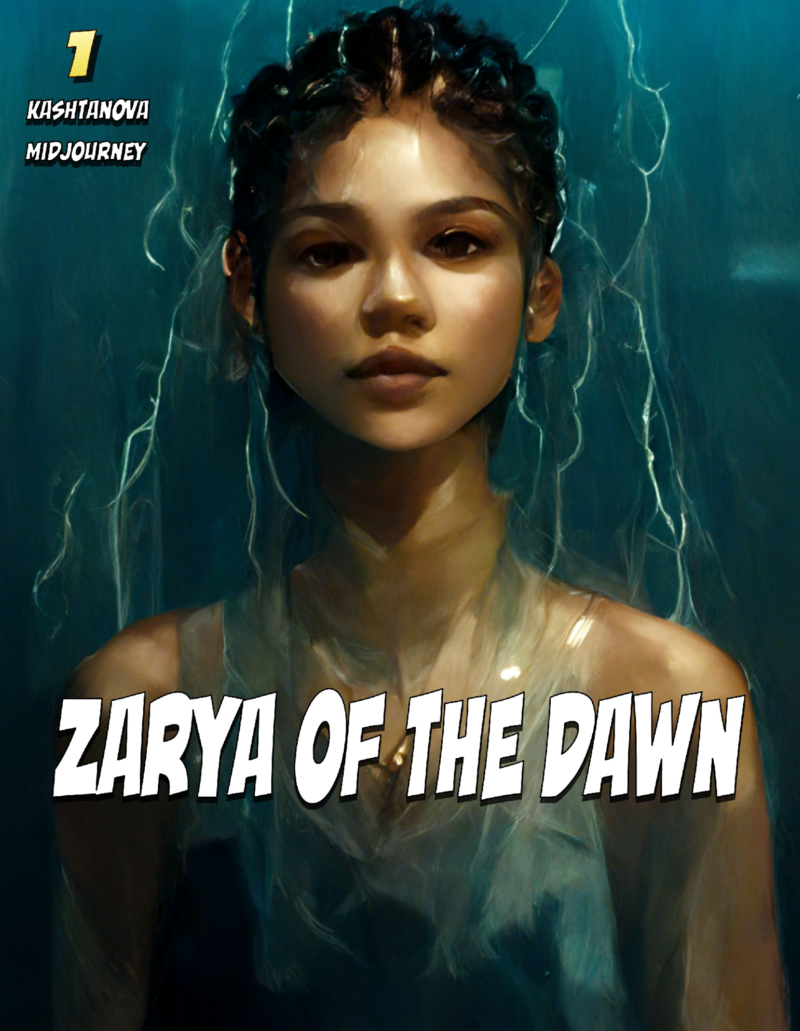
“Zarya of the Dawn” is a comic book by American artist Kris Kashtanova. The US Copyright Office ruled in 2023 that the images could not be protected by copyright because they were partially generated by the AI tool Midjourney. (Image source: wikipedia, this work is in the public domain.)
In order to reduce the potential legal risks at this stage, companies still have some supporting measures at their disposal, for example
If the generated content is to be used outside the company, such as marketing copy or advertising images, employees have to make “manual” adjustments and post-production after the content is generated before it is released externally, so as to avoid being deemed as a direct output of AI alone and losing copyright protection.
Only use AI-generated content within the enterprise and do not disclose it to the outside world. In other words, protect these content assets as trade secrets.
Since the legal status of AI-generated content has not yet been determined, most developers avoid mentioning the ownership of copyrights. In fact, the Terms of use of many AI tools also clearly state that the AI system will output very similar or even the same content to different users, which is a potential source of future disputes.
Users are still legally responsible for the content generated, but some companies provide a indemnification
If disputes arise when publishing content generated using AI, such as copyright infringement, infringement of third party privacy, defamation, or if the rights and interests of others are damaged due to errors or bias in the content, the user naturally bears legal liability and cannot be exempted on the grounds that the content was generated by AI.
Some large AI service providers, such as Google and Microsoft, provide copyright indemnification for content generated by AI. Put simply, if the published content is accused of copyright infringement by a third party, the AI service provider will provide legal assistance or directly compensate the user for the losses incurred as a result of the accusation. However, such compensation is usually subject to a cap. For example, Adobe Firefly, the generative AI function of the well-known image software Photoshop, only promises a maximum liability of $10,000.
In addition, if the user deliberately produces infringing content, the AI service provider naturally does not provide any indemnification. Some companies even explicitly require users to use specific detection tools to check whether the output content infringes on rights, and only if there is no problem will the indemnification be provided. For example, Github Copilot, which assists in writing code, requires users to turn on duplicate detection filtering to check whether the content is a duplicate of known code.
It should be noted that most of these guarantees only apply to business accounts, and individuals are often not covered. Some companies also offer this as an additional service for paid plans. For example, Adobe only indemnify output content for business users who purchase plans such as Creative Cloud Pro.
There is a risk that user-generated content may be used to train AI or simply made public
Finally, most AI service providers hope to use generated content for subsequent improvement of AI systems or for marketing purposes. This is certainly not what companies want to see. In order to reduce companies’ concerns about confidentiality and privacy, most manufacturers have provided supporting measures. For example, OpenAI has already preset not to use content to train AI for business users, so as to prevent employees from accidentally uploading company secrets. General users can manually turn off this function in the system settings.
Some companies deliberately set obstacles, such as the need to write to customer service to opt out of AI training. In contrast, the image generation software Canva is very user-friendly. In addition to giving users a convenient way to opt out, Canva also promises not to use content to train AI for educator accounts.
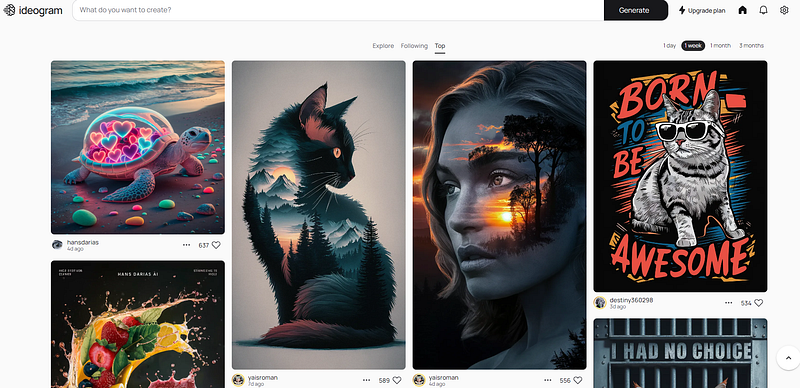
Ideogram also displays popular images recently generated by users. (Screenshot from the ideogram homepage)
Some AI manufacturers will go further and make the generated content public. This practice is very common in AI services that specialize in generating images. Since images and videos have a strong visual impact, AI companies often advertise their services by publishing selected user-generated content. In Midjourney, every generated image is published on the official Discord forum and open to secondary creation by others.
However, for many corporate clients, the risk of content being made public is significant. For example, if an image intended for advertising is made public and others are allowed to create secondary works, it may cause early exposure of the product and even affect the corporate image.
To solve those problems, Midjourney provides the “Stealth” mode, but you must purchase the aforementioned “Pro” or “Mega” plan to use it. Adobe’s Firefly also adopts a similar approach. If the user is not a paid user, the output content will be automatically licensed to Adobe. Canva’s terms of use is quite user-friendly. Unless the user shares it himself, the content will only be visible to himself.
Read the terms of use carefully, and be aware of cybersecurity vulnerabilities in self-built services
For companies, using externally provided services can quickly introduce AI technology and improve work efficiency, but it can also complicate related rights and obligations. Therefore, you should carefully read the Terms of use for every AI service before using it.
On the other hand, although companies can avoid the above disputes by creating their own AI services, in addition to investing more resources in development and subsequent maintenance, they should also consider whether their own cybersecurity systems can meet the same standards as those of major technology companies such as Google and Microsoft, so as to avoid creating an even bigger cybersecurity breach.