
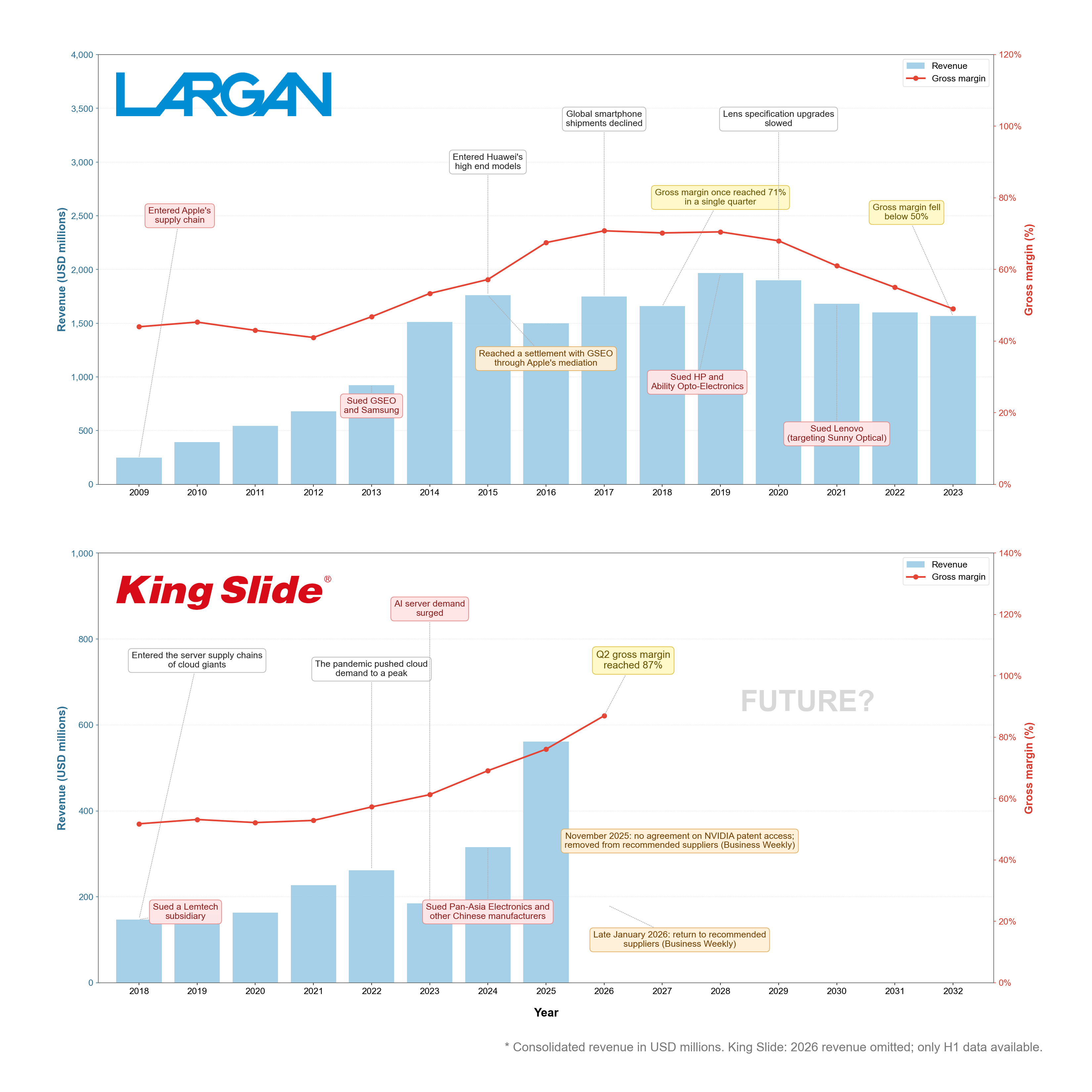
The NVIDIA events follow Business Weekly’s August 19, 2026 report (in Chinese): removal from the recommended supplier list in November 2025 and return in late January 2026. Event markers indicate timing, not additional revenue data.
Taiwan is home to many component suppliers that rank No. 1 in the world within their respective niches.
Although most of these companies are largely invisible to consumers, they occupy critical positions in global technology supply chains.
Largan Precision, the king of high end smartphone camera lenses, and King Slide, the king of AI server slide rails, are two examples.
Many people have asked this question. Slide rails are merely stamped metal components that any metalworking factory should be able to make. How can they generate a gross margin of 87%?
If patents are the reason, Largan also owned many patents. Why was Largan unable to stand up to Apple at the time, while King Slide has been able to stand up to NVIDIA?
During the peak of the smartphone era, Largan also achieved a gross margin of 71%. That was considered unbelievable at the time.
After Largan entered the iPhone supply chain in 2009, its revenue rose rapidly and competitors entered the market one after another.
Largan sued GSEO, with Apple later mediating between the two companies, and also forced Samsung to place orders with it. Largan subsequently entered Huawei’s supply chain and continued to benefit from the competition to upgrade camera lens specifications in high end smartphones.
Later, Huawei was sanctioned and the momentum behind camera lens upgrades weakened. Largan then entered fierce competition with other manufacturers in the market for mid range and low end camera lenses. Its gross margin consequently fell to below 50%.
King Slide’s current position may be comparable to where the smartphone industry was around 2014 and 2015, when profits were still very high.
King Slide sued the Chinese company Pan Asia Electronics two years ago. This was almost identical to Largan’s strategy when it sued GSEO and Samsung in 2013 to delay competitors from entering the market.
【How Long Can King Slide Maintain Its High Gross Margin? When Will Competitors Get Over the Wall?】
Largan’s gross margin declined not because its patents became weaker, but because the smartphone market became saturated after 2017.
As smartphone brands experienced declining gross margins, they began to care more about value for money than product performance. The sanctions imposed on Huawei dealt an additional blow.
How long King Slide can continue earning such profits will therefore depend on when the AI server market begins to care about value for money.
When that time comes, no matter how strong King Slide’s patents are, customers will begin looking for cheaper solutions that are good enough. King Slide will then naturally lower its prices, bringing its gross margin back to a normal level.
In summary, King Slide’s temporarily high gross margin is not entirely the result of patent protection. Several factors have come together at the same time:
- First mover advantage
King Slide was the first company to enter the supply chain. Some of the functional designs of its slide rails were incorporated into NVIDIA’s standards, making them difficult for other suppliers to avoid.
In other words, King Slide’s patents are effective not entirely because their scope is broad, but because other slide rail manufacturers are being forced to move close to King Slide’s patent firing range.
- Low product price
The cost of these “two pieces of metal” is far lower than the price of other components in an AI server rack. NVIDIA will therefore not allow the higher price of slide rails to affect server rack shipments.
- A supply chain that excludes Chinese suppliers
Chinese manufacturers enjoy low manufacturing costs, but they have difficulty entering the AI server supply chain. This has created an industry arena in which King Slide stands alone.
There is some irony here. Largan was hurt by geopolitics at the time, while King Slide is now benefiting from it.
Why are King Slide’s patents particularly effective?
- Infringement is easy to detect
Unlike software or material technologies, the physical mechanisms of slide rails are relatively easy to obtain, disassemble and compare.
NVIDIA and other suppliers therefore have difficulty pretending that they do not see the infringement.
- High patent density
Most traditional manufacturers are reluctant to spend large amounts of money applying for patents. Companies with abundant funds and large patent portfolios are generally high technology companies.
When King Slide went all out to apply for slide rail patents, few others were applying for similar patents. King Slide was therefore able to secure broader patent coverage.
Simply put, King Slide’s exceptionally high gross margin and monopolistic position were created by a combination of many extreme conditions.
Are patents the main reason?
Yes, but also no.
If AI demand had not exploded, King Slide could not have continued spending nearly NT$100 million on patents every year over the long term. I may share the calculations behind this in a future post.
Could King Slide have achieved this without patents?
Impossible.
Slide rails are not some mysterious advanced technology. Without patents, King Slide would have had very little powerful leverage in negotiations, and the market would certainly have been divided among multiple suppliers by now. A more neutral answer is that a company does not need patents to receive orders and sell products. However, patent rights are the only legal weapon that can directly remove a competitor’s product from the market.
If a company wants to achieve the kind of combined revenue and gross margin impact that King Slide has achieved, patents are indispensable. Moreover, if the company faces a patent lawsuit, it will at least have an opportunity to counterattack with its own patents.
For King Slide, the explosion in AI server demand was undoubtedly an unexpected windfall.
After market demand cools, the balancing power of patents will weaken. The remaining barriers to entry for these “two pieces of metal” will be lower than those for Largan’s optical lenses.
The important question is where King Slide will invest the money it earns during these years, just as Largan is now moving into CPO silicon photonics.
PS: This issue cannot be fully discussed in a single article because the two products remain very different:
- Server racks are sold to cloud service providers, while smartphones are consumer products. The distance between product design and end demand is therefore different.
- Slide rails are still fundamentally stamped metal components. They cannot be compared with precision optical lenses, so competitors will be able to enter the market more quickly.
- The structure of today’s global supply chain is also very different from that of the past, making future developments difficult to predict.
AI is now part of the competition between the United States and China. If slide rail customers eventually shift orders to a second supplier, King Slide may not be able to balance its customer concentration risk in the same way that Largan once did by accepting orders from Huawei.
Returning to the original question, why is King Slide’s gross margin even higher than Largan’s was at the time?
Perhaps it is because this AI wave arrived faster, more forcefully and without precedent. Customers have not yet had enough time to cultivate a second supplier, and it remains difficult to predict when the AI hardware market will become saturated.