
As AI tools rapidly evolve, they bring new challenges along with their capabilities. Recently, AI-enabled electric cars made headlines because they could answer questions about recent passengers and activities inside the car — prompting jokes about these cars being “infidelity detectors.” This has sparked a broader conversation about AI’s impact on privacy and ownership, highlighting the fast-paced, complex risks that accompany AI’s growth.
Generative AI, trained on enormous amounts of text, images, and sound data, lacks human judgment and values. It’s like a highly informed child with a photographic memory but little common sense. It often produces inaccurate or overly candid responses, requiring careful oversight. Whether using AI to create content or incorporating it into services, companies must approach AI with responsibility and caution.
This article outlines practical tips to help users mitigate the risks of AI-generated content, reduce “hallucinations,” and ensure accuracy.
Step 1: Cross-Verify for Accuracy
Large language models (LLMs) can sometimes generate plausible but entirely incorrect information due to “hallucinations.” For example, in May 2023, a U.S. lawyer faced disciplinary action after AI-generated citations in a legal document turned out to be fabricated. Despite advancements, AI often produces significant errors that need human intervention to correct.
Step 2: Does Your Writing Sound Artificial?
While generative AI can produce coherent text, its writing often has recognizable characteristics that not only reveal its source but may also hinder readability. AI-generated paragraphs, for instance, often follow a rigid structure, lacking the natural flow typical of human writing. AI also tends to overuse complex words and long sentences, which can make its writing feel stiff.
AI’s writing style can feel neutral and generic, likely due to the vast amounts of data it processes, leading to a somewhat “averaged-out” tone. AI content may also be verbose without adding real depth, leaving readers with more questions than answers. A practical solution is to “probe further,” asking for detailed explanations instead of generalizations, then organizing and refining these responses into a clearer narrative.
To add variety to AI-generated writing, you might use a “role-play” prompt, like: “Imagine you’re an experienced judge in Taiwan. Comment on this social issue in a balanced tone.” Or, you can upload a sample of a preferred writing style for AI to emulate.
Certain phrases often pop up in AI-generated content, such as “delve into” in English or “總的來說” (“in summary”) in Chinese, marking the text as machine-written. If you want to make it feel more natural, adjust or remove these recurring phrases where appropriate.
Though advanced prompts or specialized services can help, they can be complex, costly, or less effective than expected. Careful review of AI content is crucial, especially if it’s intended to pass as human-written.
Step 3: Check for “Hidden” Errors in AI-Generated Images
AI-generated images are gaining popularity, providing a quick way to create visuals without artistic skill. However, they often contain unexpected errors. In January 2024, for example, Wizards of the Coast (WotC), the company behind Dungeons & Dragons, released a set of beautiful, AI-generated cards that experts immediately recognized as artificial due to subtle inaccuracies.
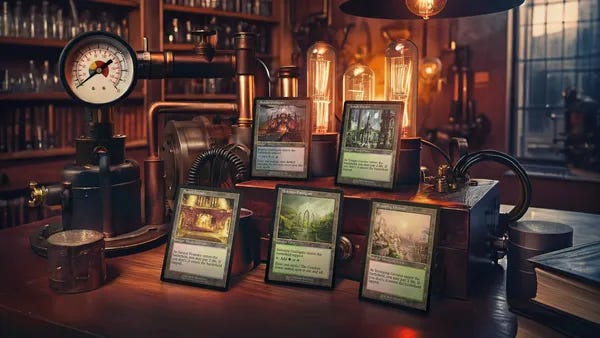
A series of new cards displayed in a vintage setting. Photo Credit: Wizards of the Coast
Dear readers, can you tell that these stunning images were created by AI? Professional artists, at least, would surely notice the difference.
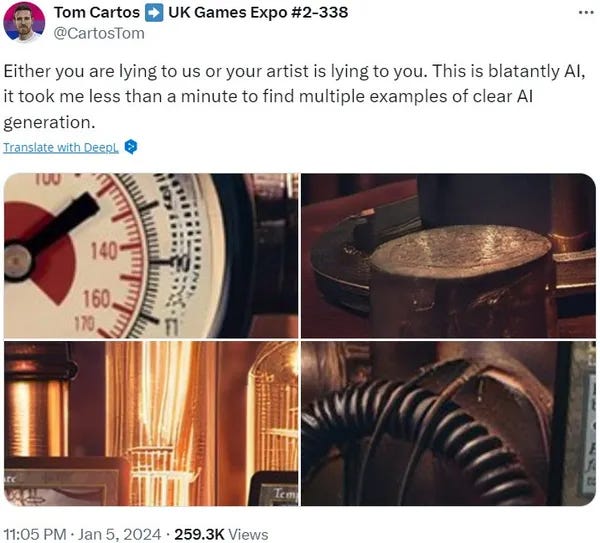
A closer look at the images reveals numerous errors, such as the spacing of markings in the top-left, the filament in the bottom-left, and several ambiguous objects. — Tom Cartos (X post)
These errors stem from AI’s limited understanding of real-world mechanics and physics, leading to mistakes that human artists wouldn’t make. Even highly refined AI images can reveal issues upon close inspection.

The author demonstrates generating an image of Taroko Gorge in Taiwan and related text using DALL-E. In the result, not only was the Chinese text rendered as unrecognizable symbols, but the English phonetics were also completely incorrect. — generated with DALL-E
A related challenge is text in images. Commercial uses, such as advertising or product packaging, often include text that AI struggles to generate accurately. Text elements may display spelling errors, misordered characters, or random symbols. Chinese text, in particular, remains difficult to produce accurately, while English is somewhat easier but still prone to mistakes. RRecently, many posters have surfaced with glaring English spelling errors, likely produced by well-intentioned individuals who tried to let AI handle the task. This can be embarrassing, especially for professionals.
For businesses, such errors can damage their professional reputation. Specialized models like Stability AI’s DeepFloyd IF can help address these issues, making them a worthwhile investment for companies with high text-image generation needs.
Encouraging a Culture of Responsible AI Use in the Workplace
AI tools are evolving rapidly, and there’s no single “right” way to use them. Different industries and roles have unique applications, and professionals in specific fields can best identify challenges. The tips here offer a starting point, but employees should leverage their domain expertise to refine their use of AI over time.
For instance, an article that seems fine to a layperson might immediately remind an expert of a famous work, requiring careful revision before publishing.
To address potential blind spots, it’s helpful to seek feedback from colleagues or friends. Having someone review AI-generated content, such as promotional materials, can uncover issues and provide new insights. This collaborative approach is both cost-effective and highly productive. Therefore, companies should promote open discussions about AI methods and outcomes, rather than just permitting “hidden” AI use. By fostering a culture of transparency and shared learning, businesses can create a healthy environment for AI innovation and adoption.