
With AI-generated content becoming increasingly mainstream, companies face a new question: could this technology bring a crisis in consumer trust? And if so, how should businesses respond?
Consider the recent experience in Taiwan. In August 2024, the Ministry of Labor published a press release sharing the story of a young job seeker, “Xiao Tang,” who found success in landing a software engineering position through a government employment program. However, the public soon discovered that “Xiao Tang’s” image was AI-generated. The ministry quickly acknowledged the mistake, amending the release to label the photo as AI-created.

“‘AI Xiao Tang’: The person look somewhat artificial, and the shape of the left hand’s fingers also appears quite odd.” — Press Release from the Ministry of Laborof Taiwan
This incident raises an important question: Should governments and private companies openly disclose when they use AI to produce content?
Why Transparency Matters with AI Content
While AI is fundamentally a tool, its ability to generate massive amounts of content at incredible speed gives it an impact far greater than that of traditional writing or design software. As AI tools continue to evolve, they are increasingly replacing tasks that once required human creativity, from writing and illustrating to producing video content. Though these technologies provide convenience, they also raise public concerns.
For instance, a 2024 study by Washington State University found that when companies mention AI in product descriptions, it often dampens consumers’ purchase intent. This may be linked to a subtle but growing mistrust of AI or a weariness over its pervasive presence. At a minimum, people generally want to know whether the content they are seeing was created by humans or by AI. No one likes feeling misled, and learning that a piece of content they connected with emotionally was generated by an algorithm instead of a person can create an uncomfortable reaction. This is why companies using AI for external marketing or customer engagement should seriously consider labeling such content.
Navigating the Added Burden of Disclosure
For companies that rely heavily on content for profit or marketing, implementing a disclosure process introduces a new management layer. In the past, firms rarely had to disclose the tools used to create their materials. But today, adopting AI requires more diligent oversight.
Some businesses may assume they can bypass detection, thinking that AI-generated images, for example, are now realistic enough to be indistinguishable from human-made ones. However, this assumption is risky and often inaccurate.
AI Detection Challenges: Can Companies Avoid Exposure?
In January 2024, the popular game Apex Legends, produced by EA, came under fire for allegedly using AI to generate in-game artwork. Sharp-eyed fans pointed out errors that would be unlikely in hand-drawn art. While these flaws might go unnoticed by the general public, they stood out to dedicated players and professional artists.

There are several unusual elements in the image, such as the deformed fingers on the left, the melting-like ties across the chest, and the strange patterns on the accessories in the right image. — Thorsten Denk (X post)
Current AI-generated visuals are still far from flawless, often displaying odd distortions or extra details due to the AI’s limited grasp of physical structures and materials. Therefore, companies that rely on AI-generated content, whether for images or videos, may find it challenging to pass these off as human-made. The best approach is transparency; companies should label AI-generated content clearly to avoid potential PR fallout.
Special Case: When Your Brand Relies on Artists
In certain industries, the backlash to AI use is particularly intense. For example, in January 2024, Wacom — a leading graphics tablet manufacturer — used what appeared to be AI-generated illustrations in a promotional campaign for the Lunar New Year. Days later, the company admitted this publicly and issued an apology, but the damage to its reputation was done.

The dragon’s tail appears detached from its body, even lying on the ground. Additionally, the dragon’s teeth look quite strange. Image: The Verge
Wacom’s customer base includes professional artists, many of whom felt betrayed. Moreover, consumers began to question Wacom’s own expertise: could a company that failed to detect AI flaws in artwork truly understand the needs of artists? For companies closely tied to creative industries, adopting AI can quickly become a reputational risk if not managed carefully.
Wacom is far from alone in facing this resistance. Other companies are also feeling the pressure. For example, Nintendo’s president publicly stated in August 2024 that the company would not use AI in its products, likely responding to concerns from its creative customer base.
AI’s Infiltration into Company Content: A Sneaky Complication
Another notable factor in the Wacom incident is that the image in question wasn’t created by the company itself; it was sourced from Adobe’s commercial image library, where it was incorrectly labeled as “non-AI.”
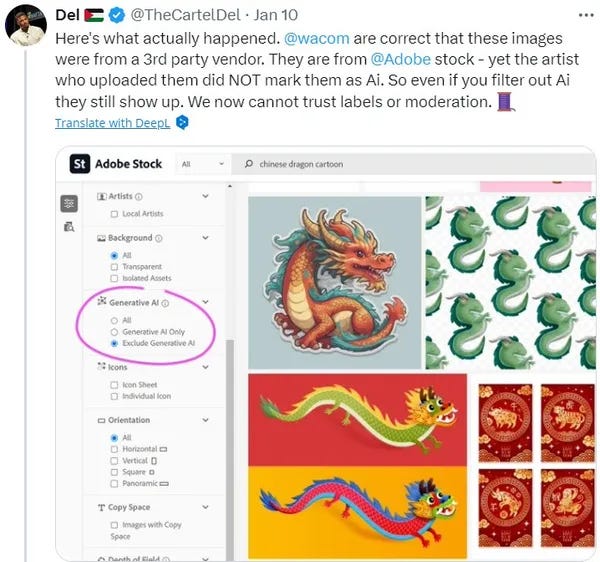
The controversial image used by Wacom was purchased from Adobe Stock, but it was labeled as non-AI-generated. — Del Walker (X post)
Though Wacom stated it had run the image through online AI-detection tools, the oversight still occurred, allowing an AI-generated image to slip through. Similarly, Dungeons & Dragons (DnD) faced criticism for allegedly using AI-generated visuals, leading the company to clarify that while AI wasn’t used to create entire images, some artists might have employed AI tools in Photoshop for minor edits. They acknowledged the challenge of managing this quickly evolving technology.

Photoshop’s built-in AI features allow users with little knowledge of image editing to easily modify images through text commands. Image: Adobe Website
As AI tools become standard features in content creation and design software, companies are encountering new difficulties in tracking and managing the sources of their content. Even if employees are instructed to avoid AI, it’s difficult to enforce these policies entirely. For outsourced projects, the challenge of content verification grows even further. Companies must therefore establish more comprehensive oversight systems, disclosing AI usage as appropriate — for instance, by labeling visuals with “Generated by DALL-E” or “Edited using Adobe Firefly.”
Establishing Records: How Companies Can Monitor AI Use Internally
How can businesses effectively monitor employees’ use of AI tools? AI-generated content should come with thorough documentation, including:
- The specific AI tool used and the account it was generated under.
- Any prompts or files that were uploaded to the system.
- The original, unedited AI output.
- Notes on any manual edits made afterward.
Documenting these details is crucial not only for transparency but also for knowledge management. This practice helps employees replicate successful processes and avoid repeating past mistakes. Internally, this approach also ensures that work can be handed off while maintaining content quality. Automated record-keeping can integrate with companies’ digital transformation efforts.
Record-keeping is particularly important in the AI era. In traditional content creation, intermediate files like Word or PSD documents may be saved. However, since AI is more of a “black box,” companies must keep records to understand how each piece of content was created. These records will also be essential for addressing potential legal issues, such as copyright, content authenticity, and ethical concerns.
Transparency Across the AI Landscape: Platforms and Companies Follow Suit
In response to public demand, several AI platforms now require that users label AI-generated content, specifying the role of AI in any collaborative work. For instance, ChatGPT and Canva have both implemented such guidelines.
Social platforms are also taking action. In 2024, Meta began automatically labeling AI-generated images on Facebook, Instagram, and Threads.

Facebook automatically labels content identified as AI-generated. — Meta Website
While this feature is still being refined and piloted in select countries, it signals a growing trend toward transparency. Content providers, especially businesses, should proactively disclose their use of AI to prevent PR issues. Consumers have a right to know if the content they are engaging with was created by a human or AI; maintaining transparency is essential for building trust.